

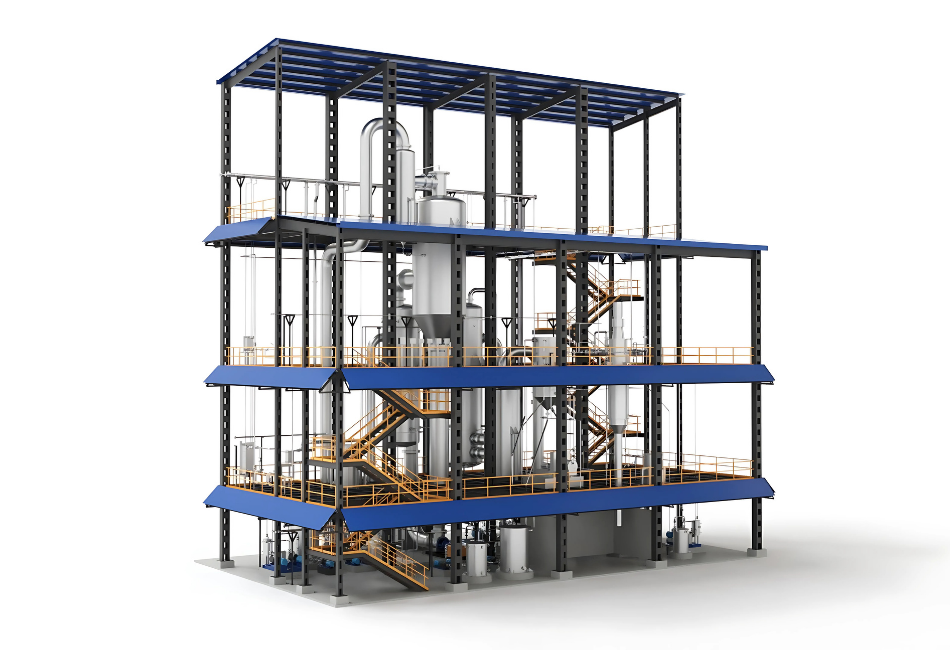
MVR Based Evaporators System

Sustainable evaporation with up to 90% energy savings.
 A modern solution designed for efficiency, economy, and the environment.

MVR Based Evaporators System

Mazda’s MVR evaporators reuse vapor as a heating medium to minimize steam usage.
 Built for industries demanding cost savings, sustainability, and reliable performance.

MVR Based Evaporators System

Product Details

Mazda’s Mechanical Vapor Recompression (MVR) Evaporator System is an advanced thermal process that dramatically reduces energy consumption by compressing and reusing vapor generated during evaporation as the heating medium. This closed-loop recycling of latent heat allows up to 90–95% savings in energy compared to conventional evaporators, while minimizing steam and water requirements. Compact, efficient, and eco-friendly, MVR systems are ideally suited for industries seeking to reduce operating costs, lower emissions, and achieve sustainable evaporation.

Advantages

  • Achieves up to 90–95% energy savings
  • Requires little to no live steam after startup
  • Reduces operating costs and utility usage
  • Compact design with smaller footprint
  • Produces reusable clean condensate
  • Eco-friendly with minimal emissions

Feed enters the evaporator and partially evaporates with initial heating. The generated vapor is compressed mechanically, raising its temperature and pressure, and is then reused as the heating source in the same system. This continuous vapor recompression cycle minimizes external energy needs, while clean condensate is collected for reuse and concentrated product is discharged.


Dairy (milk and whey concentration)

In multi-effect evaporators, capturing and reusing waste steam after the final effect

Pharmaceuticals (solvent recovery, heat-sensitive products)

Steam recovery in drying and processing stages

Zero Liquid Discharge (ZLD) systems

Energy recycling in evaporation and concentration processes

Food & Beverage (juice, sweetener concentration)

In multi-effect evaporators, capturing and reusing waste steam after the final effect

Textile and Dye Effluent Treatment

In multi-effect evaporators, capturing and reusing waste steam after the final effect

Chemical and Fertilizer Processing

In multi-effect evaporators, capturing and reusing waste steam after the final effect

MVR Based Evaporators System - FAQs

What is a Mechanical Vapor Recompression (MVR) Evaporator System?

A Mechanical Vapor Recompression (MVR) Evaporator System is an energy-efficient evaporation technology that compresses vapor generated during evaporation and reuses it as the heating medium. This recycles the vapor's latent heat and significantly reduces the need for external steam and energy.

How does an MVR evaporator work?

Feed enters the evaporator and is partially evaporated using initial heating. The generated vapor is then mechanically compressed, increasing its pressure and temperature. The compressed vapor is returned as the heating source for the evaporation process, creating a continuous vapor-recompression cycle that reduces external energy requirements.

How much energy can an MVR evaporator save?

According to Mazda's product information, its MVR systems can provide up to 90–95% energy savings compared with conventional evaporators, depending on the application and operating conditions.

Does an MVR evaporator require live steam?

MVR systems require little to no live steam after startup, because the vapor generated during evaporation is continuously compressed and reused as the heating medium. This can significantly reduce ongoing steam requirements.

What is the difference between MVR and MEE evaporators?

An MEE system improves steam economy by reusing vapor between multiple evaporation effects. An MVR system mechanically compresses the generated vapor and recycles its latent heat within the same evaporation process. MVR can therefore provide substantially lower external steam and energy requirements, depending on the process.

What is the difference between MVR and TVR evaporators?

Both technologies reuse vapor generated during evaporation, but they use different recompression methods. TVR uses high-pressure motive steam and a thermocompressor, while MVR uses mechanical compression to raise the vapor's pressure and temperature. The appropriate option depends on process conditions, available utilities, energy requirements, and project economics.

Can the condensate from an MVR evaporator be reused?

Yes. Mazda's MVR system produces clean condensate that can be collected for reuse, helping reduce water consumption and supporting more sustainable plant operation.

What are the main advantages of an MVR evaporator?

Key advantages include high energy savings, significantly reduced steam consumption, lower operating costs, compact equipment design, reduced water requirements, reusable clean condensate, and lower emissions.

Is an MVR evaporator suitable for sustainable industrial evaporation?

Yes. MVR technology is particularly suited to plants seeking to reduce energy consumption, steam requirements, water usage, operating costs, and emissions while maintaining continuous evaporation performance.

Why choose Mazda Limited for MVR Evaporator Systems?

Mazda Limited designs and supplies Mechanical Vapor Recompression Evaporator Systems that reuse generated vapor as the heating medium. Its MVR systems are engineered for energy-efficient evaporation, compact installation, reduced utility consumption, and sustainable industrial processing.

<< 1 >>


For any inquiries or assistance, our team is ready to offer professional support and guidance. Reach out to us, and we will respond promptly to meet your needs.

Request a Demo – Share Your Info