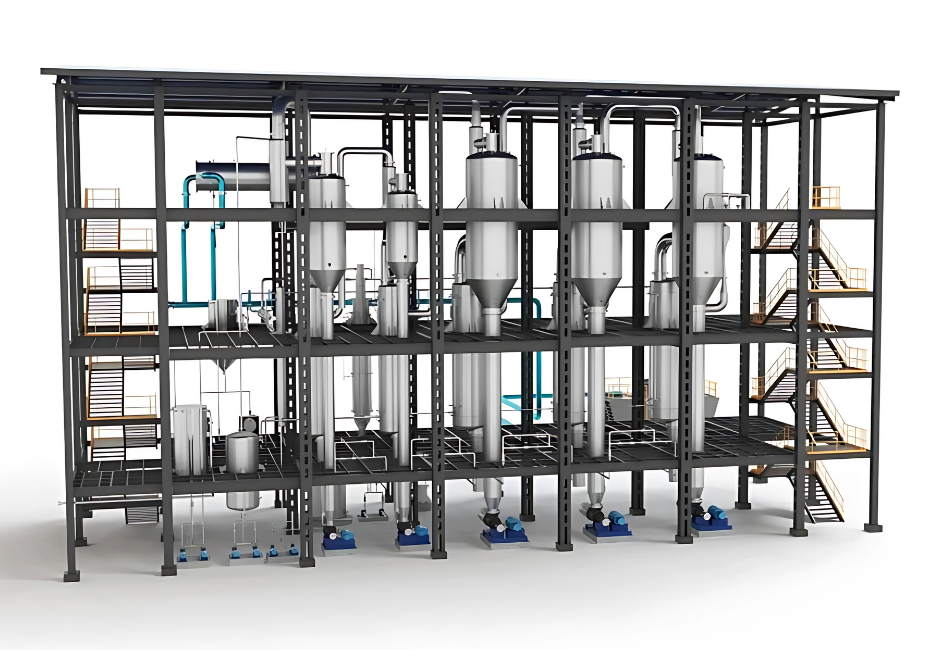
Thermal Vapor Recompression (TVR) Evaporator System

Harnessing the power of steam recompression to maximize efficiency.
Mazda’s TVR systems deliver higher steam economy with lower capital and operating costs.

Thermal Vapor Recompression (TVR) Evaporator System

Advanced evaporation system that reuses process vapor through steam ejectors.
A cost-effective bridge between traditional MEE and advanced MVR technologies.

Thermal Vapor Recompression (TVR) Evaporator System

Product Details

Mazda’s Thermal Vapor Recompression (TVR) Evaporator System is an energy-efficient solution that reduces live steam demand by recompressing part of the generated vapor and reusing it as a heating medium. This process delivers up to 50% savings in steam consumption while ensuring stable, reliable performance with minimal maintenance. Positioned between Multiple Effect Evaporators (MEE) and Mechanical Vapor Recompression (MVR), TVR offers industries the benefits of strong energy savings, simple operation, and a lower investment cost compared to MVR systems — making it a smart choice for plants focused on efficiency and sustainability.

Advantages

  • Provides significant energy savings by reducing live steam demand.
  • Ensures low operating costs with no moving parts and simple operation.
  • Offers a lower capital cost than MVR while delivering improved steam economy.
  • Compact and easy to integrate with existing evaporation systems.
  • Reliable and low-maintenance with long service life.

The TVR system operates by mixing a portion of the vapor generated in the evaporator with high-pressure motive steam inside a thermocompressor. This raises the pressure and temperature of the vapor, enabling it to be reused as the heating medium in the heat exchanger. The process minimizes fresh steam consumption while maintaining efficient evaporation, with steam economy reaching 1.3–2.0 kg of water per kg of steam. When combined with MEE, efficiency can be pushed even higher.

Dairy Industry
(Milk, Whey, Lactose Concentration)

In multi-effect evaporators, capturing and reusing waste steam after the final effect

Food & Beverage
(Juice, Syrup Concentration)

Steam recovery in drying and processing stages

Pharmaceuticals
(Extract Concentration)

Energy recycling in evaporation and concentration processes
Textiles & Dyeing
(Chemical Recovery)

In multi-effect evaporators, capturing and reusing waste steam after the final effect

Pulp & Paper
(Black Liquor Evaporation)

In multi-effect evaporators, capturing and reusing waste steam after the final effect

Wastewater Treatment
(ZLD Systems)

In multi-effect evaporators, capturing and reusing waste steam after the final effect

Thermal Vapor Recompression (TVR) Evaporator System - FAQs

What is a Thermal Vapor Recompression (TVR) Evaporator System?

A Thermal Vapor Recompression (TVR) Evaporator System is an evaporation technology that reuses generated process vapor by recompressing it with high-pressure motive steam. The recompressed vapor is then reused as a heating medium, reducing the requirement for fresh steam.

How does a TVR evaporator work?

In a TVR system, a portion of the vapor generated during evaporation is mixed with high-pressure motive steam inside a thermocompressor. The mixture is recompressed, increasing its pressure and temperature, and is then reused as the heating medium in the evaporator heat exchanger. This reduces fresh steam consumption.

How much steam can a TVR evaporator save?

Mazda's TVR system is designed to provide up to 50% savings in steam consumption, depending on the process and operating conditions. The actual steam savings depend on factors such as evaporation capacity, operating pressure, and system configuration.

What is the steam economy of a TVR evaporator?

The TVR system described by Mazda can achieve a steam economy of approximately 1.3–2.0 kg of water evaporated per kg of steam, depending on the operating configuration and process conditions.

What is the difference between TVR, MEE and MVR evaporators?

MEE improves steam economy by reusing vapor across multiple evaporation effects. TVR uses high-pressure motive steam and a thermocompressor to recompress part of the generated vapor, while MVR uses mechanical compression to raise vapor pressure and temperature for reuse.

TVR can provide a balance between energy savings, operating simplicity, and investment cost, positioning it between conventional MEE and MVR for certain applications.

Is TVR more cost-effective than MVR?

TVR can offer a lower capital cost than MVR while still providing improved steam economy. It can therefore be considered where a plant wants to reduce steam consumption without the higher investment associated with mechanical vapor recompression. The appropriate technology depends on the specific process and operating requirements.

Can a TVR system be combined with an MEE system?

Yes. A TVR system can be integrated with Multi Effect Evaporator (MEE) systems to further improve steam economy and energy efficiency. The combination can provide higher overall evaporation efficiency than conventional MEE alone.

Does a TVR evaporator have moving parts?

The TVR system uses a thermocompressor rather than mechanical compression equipment, allowing simple operation with no moving parts in the recompression system. This contributes to low maintenance requirements and reliable operation.

Can a TVR evaporator be integrated into an existing evaporation system?

Yes. Mazda's TVR systems are designed to be compact and easy to integrate with existing evaporation systems, making them suitable for plants looking to improve steam economy without necessarily replacing the complete evaporation process.

Why choose Mazda Limited for TVR Evaporator Systems?

Mazda Limited designs and supplies Thermal Vapor Recompression Evaporator Systems using thermocompressor-based vapor recompression technology. Mazda's TVR systems are engineered to reduce live steam demand, improve steam economy, and provide a reliable, low-maintenance solution for industrial evaporation applications.

<< 1 >>


For any inquiries or assistance, our team is ready to offer professional support and guidance. Reach out to us, and we will respond promptly to meet your needs.

Request a Demo – Share Your Info
