


Read Our Article
Venturi Scrubber vs. Packed Tower Scrubber: Which Air Pollution Control Solution Do You Need?

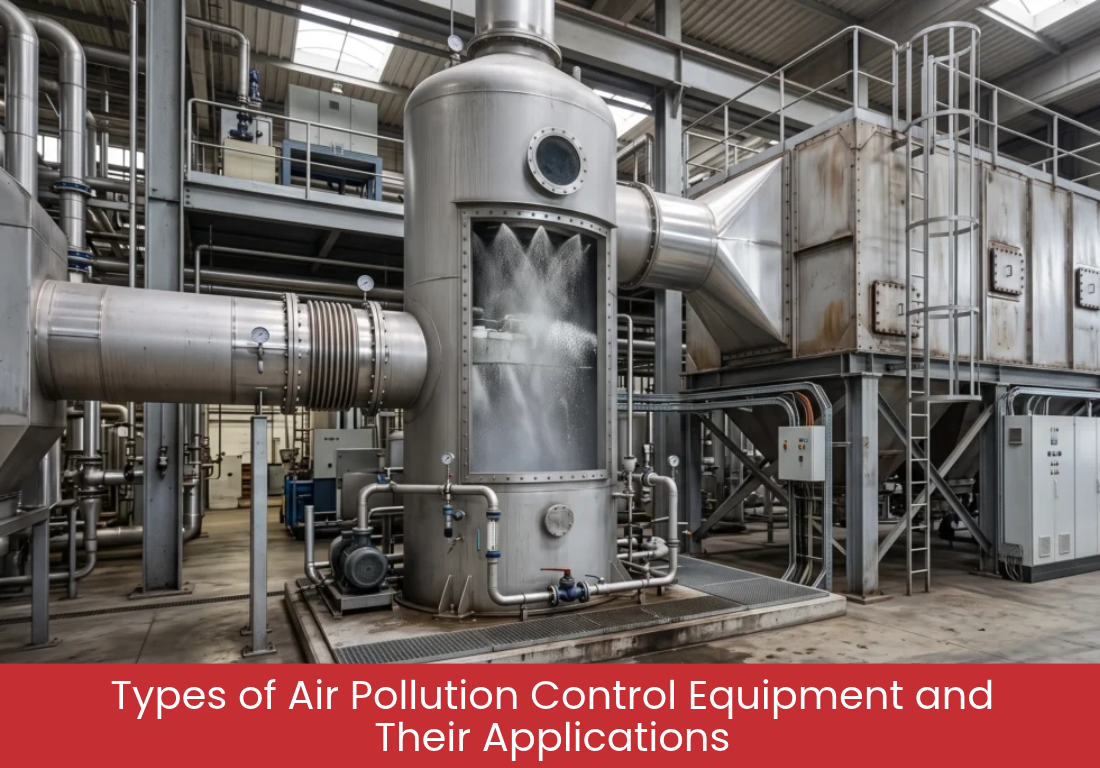
Industrial gas streams carry a wide mix of contaminants, including fumes, vapours, dust, sub-micron particles, acid mists and odours. No single device handles all of them equally well. Some equipment excels at absorbing gases, some at capturing fine dust, and some at collecting mists from saturated gas streams.
Choosing the right air pollution control equipment starts with knowing what each type does best. This guide compares four widely used technologies: the Jet Venturi Fume Scrubber, the Packed Tower Scrubber, the High Energy Venturi Scrubber and the Wet Electrostatic Precipitator (WESP). It then shows which one fits which situation.
| Comparison Factor | Jet Venturi Fume Scrubber | Packed Tower Scrubber | High Energy Venturi Scrubber | Wet ESP |
|---|---|---|---|---|
| Operating Principle | High-velocity liquid spray entrains and scrubs gas | Gas and liquid contact over a packed bed | High-velocity gas atomizes liquid into fine droplets | High-voltage field charges and collects particles |
| Flow Pattern | Co-current | Countercurrent | Gas-driven through Venturi throat | Gas passes through electrode collector |
| What Drives the Process | Scrubbing liquid | Liquid flowing over packing | Gas stream energy | Electrical field |
| Main Targets | Fumes, gases, particulates, odours | Pollutants and process gases | Fine dust, fumes, sub-micron particles | Fine mists, aerosols, sub-micron particulates |
| Standout Feature | Handles high volumes of contaminated gas | Low pressure drop, maximum absorption | Captures particles below 1 micron | Up to 99.9% collection efficiency |
| Moving Parts | None | Not applicable | None | Not applicable |
The first three are wet scrubbers: they use a scrubbing liquid to capture contaminants. The fourth, the Wet ESP, uses an electrical field to do the work, with water used to wash collected material off the collection surfaces.
What it is: A non-mechanical scrubber engineered to handle high volumes of contaminated gas, for both air pollution control and recovery of valuable byproducts.
How it works: High-pressure scrubbing liquid, typically water, is sprayed through a nozzle into a cone-shaped throat. The liquid accelerates rapidly and creates a vacuum effect that draws the contaminated gas in. Gas and liquid mix in the Venturi throat, flowing in the same direction, where scrubbing takes place. A separator then removes the liquid along with the captured pollutants, and the clean gas is discharged.
Best suited for:
Key advantages:
What it is: A countercurrent gas scrubber in which gas flows upward through a packed bed while scrubbing liquid flows downward, used for air pollution control and specialized process applications.
How it works: Gas enters at the bottom of the tower and rises through the packing, while scrubbing liquid is distributed from the top and flows down over it. The packing provides a large surface area, so gas and liquid make close contact and pollutants or process gases are absorbed. A mist eliminator ensures clean gas discharge, and the liquid is recycled or drained.
Best suited for:
Key advantages:
Our Other Product
What it is: An advanced scrubber designed to capture fine dust, fumes and gases where conventional systems fall short.
How it works: This scrubber reverses the Jet Venturi’s approach. Here, the gas stream provides the energy. Gas accelerates through the Venturi throat and atomizes the scrubbing liquid into a mist of ultra-fine droplets. Dust, fumes and gases are captured by these droplets through impact and turbulence. The mixture then passes to a separator, where clean gas is discharged and liquid is recycled or drained.
Best suited for:
Key advantages:
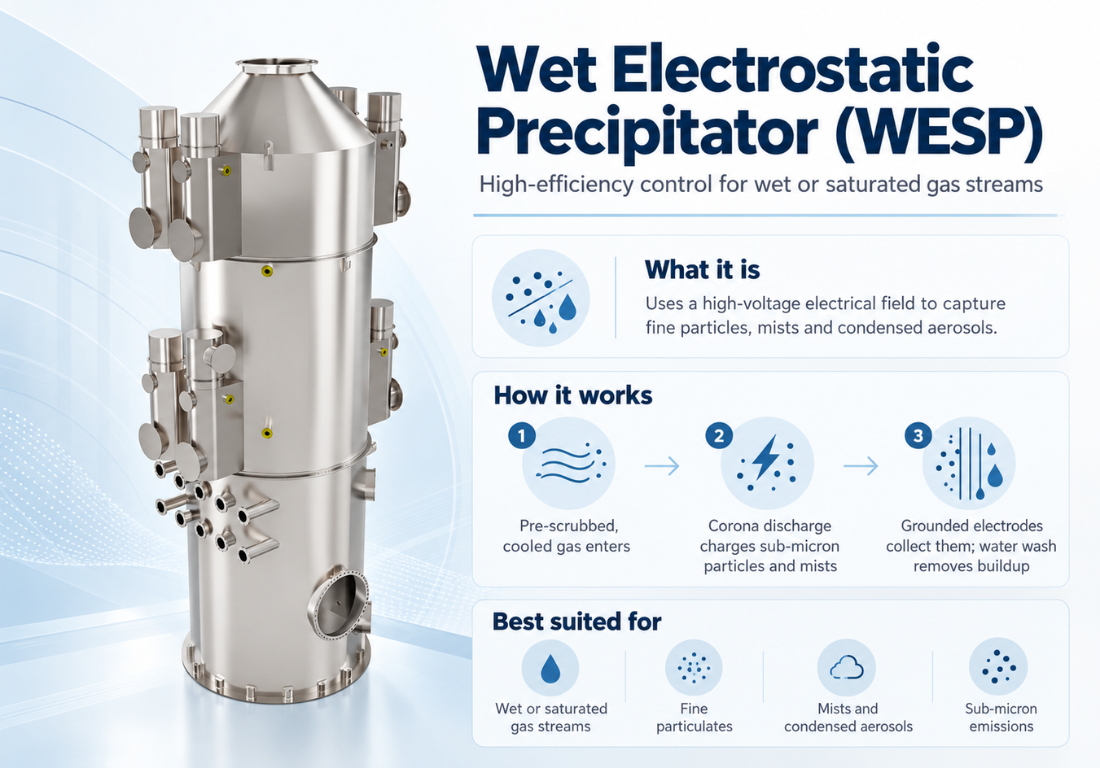
What it is: A high-efficiency air pollution control device for wet or saturated gas streams. It uses a high-voltage electrical field rather than a scrubbing liquid to capture fine particles, mists and condensed aerosols.
How it works: Gas enters the WESP after being pre-scrubbed and cooled. Inside the collector, high-voltage electrodes create a corona discharge that ionizes the gas stream. Sub-micron particles and mists become electrically charged and are attracted to grounded collection electrodes. These surfaces are periodically washed down with water to remove the accumulated material.
Best suited for:
Key advantages:
Read Our Article
Air Pollution Scrubber: Different Types, Efficiency & Selection
Start with the problem you need to solve, then match it to the technology.
“We need to absorb pollutants or process gases efficiently, with low pressure drop.”
→ A Packed Tower Scrubber. Its countercurrent design and large packing surface area are built for maximum absorption.
“We handle high volumes of corrosive gases like SO₂, HCl or NH₃ on a continuous basis.”
→ A Jet Venturi Fume Scrubber. It handles high gas loads and corrosive, high-temperature conditions with no moving parts, and it can also recover byproducts.
“Our problem is very fine dust or fumes, and conventional scrubbers aren’t capturing it.”
→ A High Energy Venturi Scrubber. It is designed for sub-micron particles, and adjustable throats let it cope with fluctuating gas flows.
“Our gas stream is wet or saturated, carries acid mists or heavy metals, and we must meet strict emission limits.”
→ A Wet ESP. It reaches up to 99.9% collection efficiency at very low pressure drop.
“We’re not sure which category our problem falls into.”
→ Begin with your gas composition, flow rate, temperature, contaminant type and particle size, plus the emission standard you must meet. These inputs determine which technology, or which combination, is right.
These technologies are not always alternatives to one another. A Wet ESP, for example, works on gas that has already been pre-scrubbed and cooled, which shows how scrubbing and electrostatic collection can work together in a single system. Where a gas stream contains both absorbable gases and fine mists or particles, a combined arrangement may deliver results that no single device can achieve on its own.
At Mazda Limited, our Air Pollution Control Division designs and manufactures all four technologies covered in this guide:
Because we offer the full range, we can recommend the technology that genuinely fits your gas stream rather than adapting a single product to every problem. Each system is engineered around your process conditions, with materials of construction selected for corrosion resistance and long service life.
Share your gas composition, flow rate, operating temperature and emission requirements, and our team will help identify the right solution.
Our Other Product
Both use a Venturi throat, but the energy comes from different sources. In a Jet Venturi, high-pressure liquid sprayed through a nozzle draws in and scrubs the gas. In a High Energy Venturi, the high-velocity gas stream atomizes the liquid into ultra-fine droplets, which makes it especially effective for sub-micron particles.
A Packed Tower Scrubber uses countercurrent flow over a packed bed, with gas rising and liquid falling, to maximize absorption at low pressure drop. Venturi scrubbers bring gas and liquid together in a throat at high velocity and then separate them. The Jet Venturi uses co-current flow driven by the liquid, while the High Energy Venturi uses atomization driven by the gas.
A Wet ESP is the stronger choice for wet or saturated gas streams containing fine mists, aerosols, acid mists or heavy metals, especially where stringent emission standards apply. It achieves up to 99.9% collection efficiency at very low pressure drop.
Both the High Energy Venturi Scrubber and the Wet ESP are designed for sub-micron particles. The High Energy Venturi captures them with fine droplets through impact and turbulence, while the Wet ESP charges and collects them electrostatically. The right choice depends on whether the gas stream is wet or saturated and on the emission standard required.
All four can be built with corrosion-resistant materials. The Jet Venturi Fume Scrubber is specifically effective on gases such as SO₂, HCl, HF, NH₃ and SiF₄, and it also handles high-temperature conditions.
The Jet Venturi and High Energy Venturi scrubbers have no moving parts, which keeps maintenance low. The Packed Tower relies on liquid flowing over static packing, and the Wet ESP uses electrodes with periodic water washing, which supports continuous, low-maintenance operation.
Each type of air pollution control equipment is built for a different job. Packed towers maximize absorption, Jet Venturi scrubbers handle high-volume corrosive gas loads, High Energy Venturi scrubbers capture the finest dust and fumes, and Wet ESPs collect mists and sub-micron particles from saturated gas at very high efficiency.
Matching the technology to your contaminants, gas conditions and emission targets is what delivers reliable compliance at a sensible operating cost. With all four technologies in our range, we can help you make that match.





Our team is available to provide professional support and will respond promptly to any inquiries or assistance you need.