


Read Our Article
Air Pollution Scrubber: Different Types, Efficiency & Selection

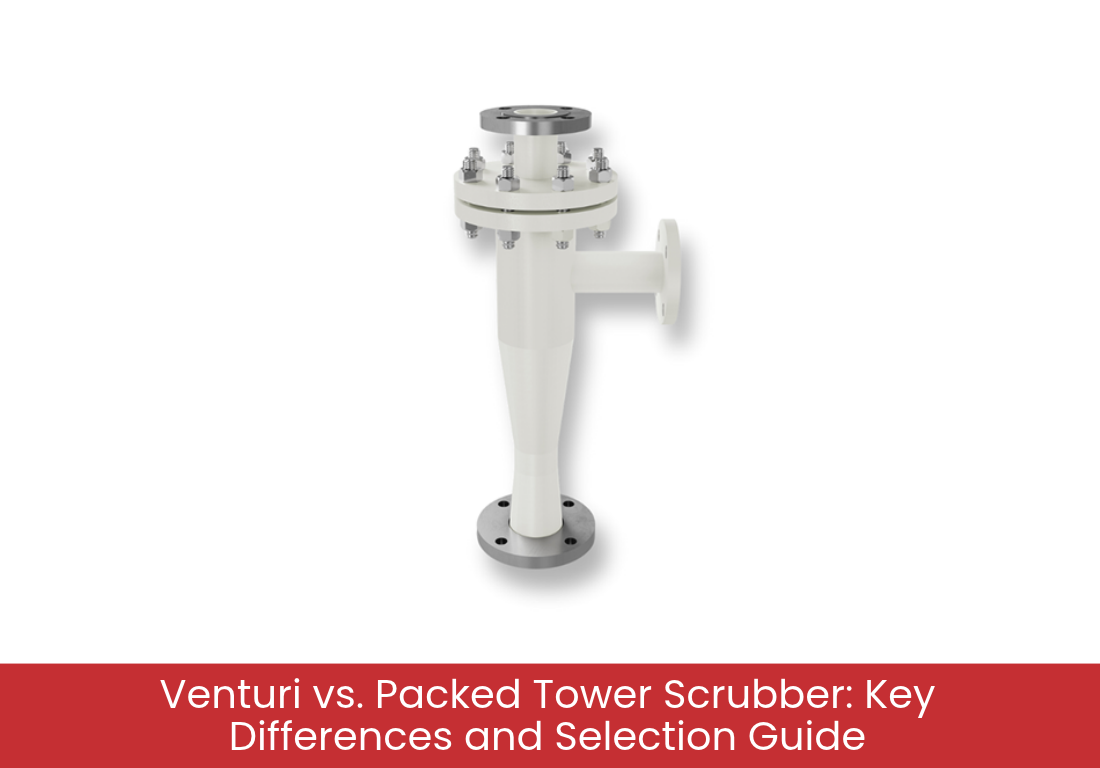
When a plant needs to clean an exhaust or process gas stream, two wet scrubber designs often make the shortlist: the Venturi scrubber and the packed tower scrubber. Both use a scrubbing liquid to capture contaminants, and both separate that liquid from the clean gas before discharge. Beyond that, they work on different principles and are built for different jobs.
There’s also a common source of confusion. “Venturi scrubber” is often treated as a single technology, but the two Venturi designs behave quite differently. Comparing the right Venturi design against a packed tower is what leads to the right decision.
This guide gives a direct comparison of the two technologies and shows how to decide which one your plant needs.
The sections below explain why.
Both Venturi designs use a Venturi throat, a narrowed section where gas and liquid meet and mix intensely. The key difference is which fluid supplies the energy.
High-pressure scrubbing liquid, typically water, is sprayed through a nozzle into a cone-shaped throat. The liquid accelerates rapidly and creates a vacuum effect that draws the contaminated gas in. Gas and liquid flow together (co-current) through the throat, where scrubbing takes place. A separator then removes the liquid along with the captured pollutants, and the clean gas is discharged.
This design operates efficiently at low velocities, has no moving parts, and is built to handle high volumes of contaminated gas.
Read Our Article
Air Pollution Scrubber: Different Types, Efficiency & Selection
Here the roles reverse. The gas stream accelerates through the Venturi throat and atomizes the scrubbing liquid into a mist of ultra-fine droplets. Dust, fumes and gases are captured by these droplets through impact and turbulence. The mixture then passes to a separator, where clean gas is discharged and the liquid is recycled or drained.
This design is aimed at fine and sub-micron particles, and its throat can be fixed, variable or manually adjustable to suit steady or fluctuating gas flows.
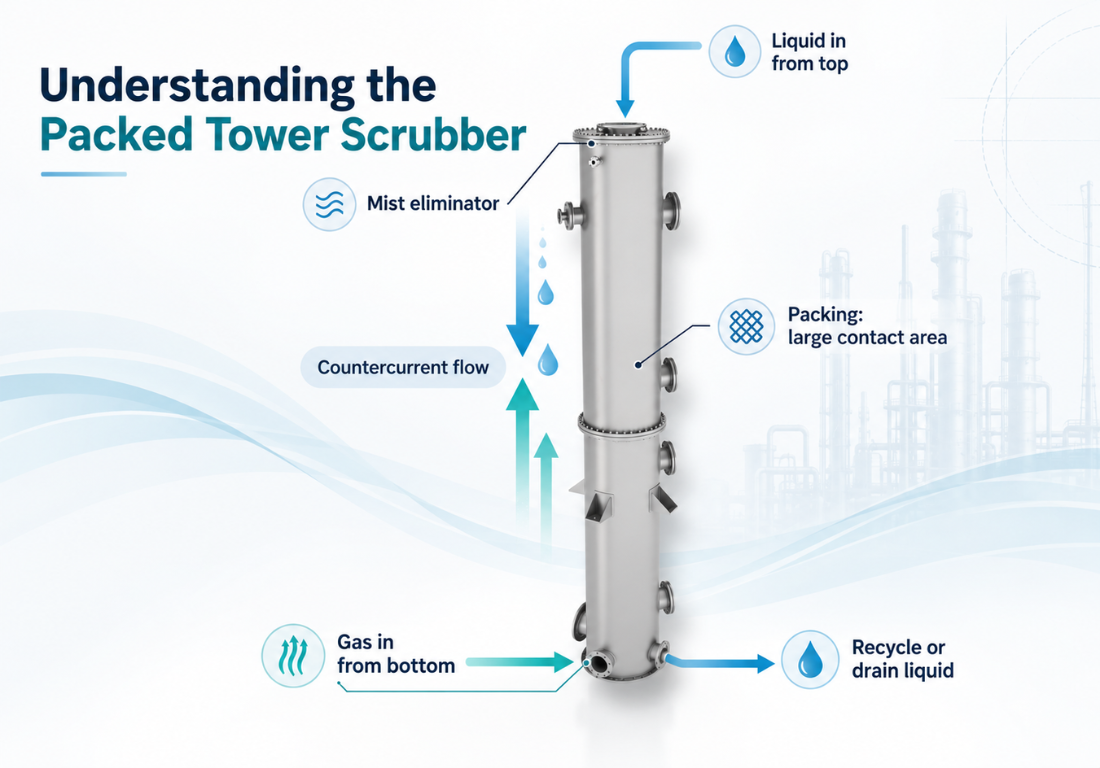
A packed tower scrubber is a vertical tower filled with packing. Gas enters at the bottom and rises through the packed bed, while scrubbing liquid is distributed from the top and flows down over the packing. Because the gas and liquid move in opposite directions (countercurrent), the rising gas stays in close contact with the liquid throughout the tower.
The packing provides a large surface area for contact while keeping pressure drop low. A mist eliminator at the top ensures clean gas discharge, and the liquid at the bottom is recycled or drained. Each tower is optimized for packing type, liquid chemistry and operating conditions.
Our Other Product
| Factor | Jet Venturi Fume Scrubber | High Energy Venturi Scrubber | Packed Tower Scrubber |
|---|---|---|---|
| Contact method | High-pressure liquid spray in a Venturi throat | Gas atomizes liquid into fine droplets in a Venturi throat | Liquid flows over a packed bed |
| Flow pattern | Co-current | Gas-driven through the throat | Countercurrent |
| Energy source | Scrubbing liquid | Gas stream | Liquid distributed over packing |
| Primary strength | High-volume removal of fumes, gases, odours and particulates | Capture of fine dust and sub-micron particles | Maximum absorption efficiency |
| Stated efficiency | Dust and particulate removal above 99% | High-efficiency removal of particles below 1 micron | Maximum absorption with low pressure drop |
| Gas contaminants named | SO2, HCl, HF, NH3, SiF4 and others | Dust, fumes and gases | Pollutants and process gases |
| Velocity / pressure drop | Operates efficiently at low velocities | Uses the energy of a high-velocity gas stream | Low pressure drop |
| Moving parts | None | None | Static packing |
| Handles fluctuating flow | Built for continuous duty | Yes, with variable or adjustable throats | Engineered to operating conditions |
| Installation | Engineered per application | Horizontal or vertical | Vertical tower |
| Materials | Fibreglass, stainless steel, lined metals | Fibreglass, steel, stainless steel, Incoloy, rubber-lined | Wide range for corrosion resistance and cost |
| Liquid handling | Once-through or recirculating | Recycled or drained | Once-through or recycle |
| Gas-liquid separation | Integrated separator | Separator | Mist eliminator |
Despite their differences, all three designs share several strengths:
The biggest difference lies in the target contaminant. Packed towers are built for absorption: drawing pollutants and process gases into the liquid across a large contact surface. Venturi scrubbers are built for intense mixing in the throat, which makes them strong on fumes, particulates and, in the High Energy design, sub-micron dust.
In a packed tower, gas and liquid meet gradually over the full height of the packed bed. In a Venturi scrubber, they meet in one concentrated zone, the throat, where mixing is rapid and intense.
The Jet Venturi is engineered for high volumes of contaminated gas in continuous-duty service. The High Energy Venturi adapts to both steady and fluctuating flows through variable or manually adjustable throats. Packed towers are engineered around specific operating conditions and can be built for anything from small-scale to large industrial installations.
All three can be built for corrosive service. Both Venturi designs are also specifically suited to high-temperature gas streams, and the Jet Venturi is effective on corrosive gases such as SO₂, HCl, HF, NH₃ and SiF₄.
The High Energy Venturi offers horizontal or vertical installation and a choice of throat configuration. The packed tower offers flexibility through customizable packing types and liquid chemistry. The Jet Venturi offers once-through or recirculating designs with integrated separators.
Not sure? Start with your gas composition, the contaminants you need to remove, gas flow rate and pattern, temperature and the emission standard you must meet. These inputs point clearly to the right technology.
If your gas stream is wet or saturated and carries fine mists, acid mists, heavy metals or condensed aerosols, a Wet Electrostatic Precipitator (WESP) may outperform both scrubber types. A Wet ESP uses a high-voltage electrical field rather than a scrubbing liquid and achieves up to 99.9% collection efficiency at very low pressure drop.
At Mazda Limited, we design and manufacture both Venturi and packed tower scrubbers through our Air Pollution Control Division, so we can recommend the technology that genuinely fits your gas stream:
Every system we build is engineered around your process conditions, with materials selected for corrosion resistance and long service life. Share your gas composition, flow rate, temperature and emission requirements, and we will help you choose the right solution.
A Venturi scrubber brings gas and liquid together in a narrow throat for rapid, intense mixing. A packed tower scrubber uses countercurrent flow over a packed bed, where gas rises and liquid flows down, giving gradual contact across a large surface area for maximum absorption.
Venturi scrubbers are generally the stronger choice for particulates. A Jet Venturi Fume Scrubber achieves dust and particulate removal above 99%, while a High Energy Venturi Scrubber is designed for sub-micron particles below 1 micron.
A packed tower scrubber is designed for maximum absorption efficiency, making it well suited to applications focused on pollutants and process gases. A Jet Venturi scrubber is also effective on corrosive gases such as SO₂, HCl, HF, NH₃ and SiF₄, particularly at high volumes.
The packed tower scrubber is designed for low pressure drop with a large surface area for effective scrubbing. The Jet Venturi scrubber operates efficiently at low velocities.
In a Jet Venturi, high-pressure liquid sprayed into the throat draws in and scrubs the gas. In a High Energy Venturi, the high-velocity gas atomizes the liquid into ultra-fine droplets, which makes it especially effective for sub-micron particles.
Yes. All three designs can be built from corrosion-resistant materials, including fibreglass, stainless steel, lined metals, Incoloy and rubber-lined construction, depending on the type. Both Venturi designs also handle high-temperature conditions.
Venturi and packed tower scrubbers are both proven air pollution control solutions, but they solve different problems. Packed towers deliver maximum absorption at low pressure drop. Jet Venturi scrubbers handle high-volume, corrosive and continuous-duty gas loads. High Energy Venturi scrubbers capture fine and sub-micron particles that other systems miss.
Identify what you need to remove and how your gas stream behaves, and the right choice usually becomes clear. We manufacture all of these technologies and can engineer the solution your process needs.





Our team is available to provide professional support and will respond promptly to any inquiries or assistance you need.