


Read Our Article
Vacuum Pump Manufacturer in India: Types of Industrial Vacuum Pumps & Systems
Industrial air pollution control equipment helps industries reduce dust, fumes, gases, mists, aerosols, and other harmful emissions produced during manufacturing. Mazda Limited offers specialized solutions including Jet Venturi Fume Scrubbers, Packed Tower Scrubbers, High Energy Fume Scrubbers, and WET Electrostatic Precipitators (WET ESP). Each technology is designed for specific pollutants and operating conditions, helping improve emission control, workplace safety, equipment protection, and environmental compliance. Choosing the right system depends on factors such as gas composition, flow rate, temperature, moisture, particle size, removal efficiency, corrosion, pressure drop, and available space. Mazda provides customized engineering, equipment selection, material options, system integration, and technical support for diverse industrial air pollution control applications.
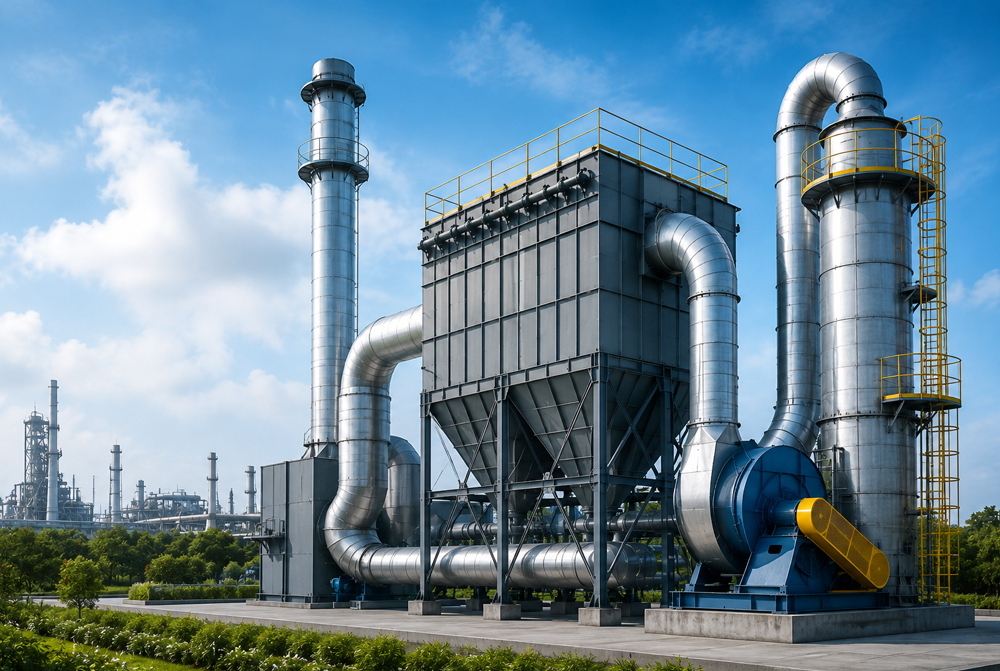
Air pollution control is an important requirement for industries that generate dust, fumes, acid gases, mists, aerosols, and other contaminants during manufacturing and processing. Selecting the right emission-control equipment helps industries manage process emissions, protect downstream equipment, improve workplace conditions, and meet applicable environmental requirements.
Mazda Limited is an air pollution control equipment manufacturer and supplier in India, offering engineered systems for industrial gas cleaning and emission control. Established in 1977, Mazda has extensive experience in designing and manufacturing process equipment for demanding industrial applications. Its Air Pollution Control Division offers Jet Venturi Fume Scrubbers, Packed Tower Scrubbers, High Energy Fume Scrubbers, and Wet Electrostatic Precipitators (WET ESP).
Each system can be selected and engineered according to factors such as gas composition, flow rate, temperature, particulate size, pollutant characteristics, required removal efficiency, and plant operating conditions. This application-focused approach allows industrial buyers to select air pollution control equipment that is suited to their specific process rather than relying on a one-size-fits-all configuration.
Industrial processes can release different types of contaminants, including particulate matter, chemical fumes, acid gases, fine dust, mist, aerosols, and process vapors. The type and concentration of these emissions vary significantly from one process to another, which makes appropriate pollution-control technology an important part of plant design.
Effective industrial air pollution control equipment can help:
Different pollutants require different removal mechanisms. Wet scrubbers use gas-liquid contact to capture particulates or absorb gaseous contaminants, while WET ESP technology uses an electrical field to capture fine particles, mists, and aerosols. In some applications, multiple technologies may be combined to achieve the required emission-control performance.
Air pollution control systems are used across a wide range of industrial processes where contaminated gas streams need to be treated before discharge. Depending on the process and pollutants involved, applications can include:
Chemical manufacturing can generate acid gases, fumes, particulates, and other process contaminants. Scrubbers and related gas-cleaning systems can be designed to treat these streams according to their chemical composition.
Fertilizer processes can produce particulate matter, fumes, and process gases. Properly designed emission-control equipment can help manage these contaminants and support cleaner plant operations.
High-temperature industrial processes can generate dust, fumes, and fine particulate matter. High-energy scrubbing technologies can be considered where fine-particle removal is a key requirement.
Pharmaceutical and chemical processes may generate fine particles, vapors, and process exhaust. Gas-cleaning systems can be selected according to the characteristics of the specific exhaust stream.
Industrial plants across different sectors may require customized systems for treating contaminated process exhaust. The appropriate equipment depends on the gas flow, pollutant characteristics, temperature, moisture content, and required emission performance.
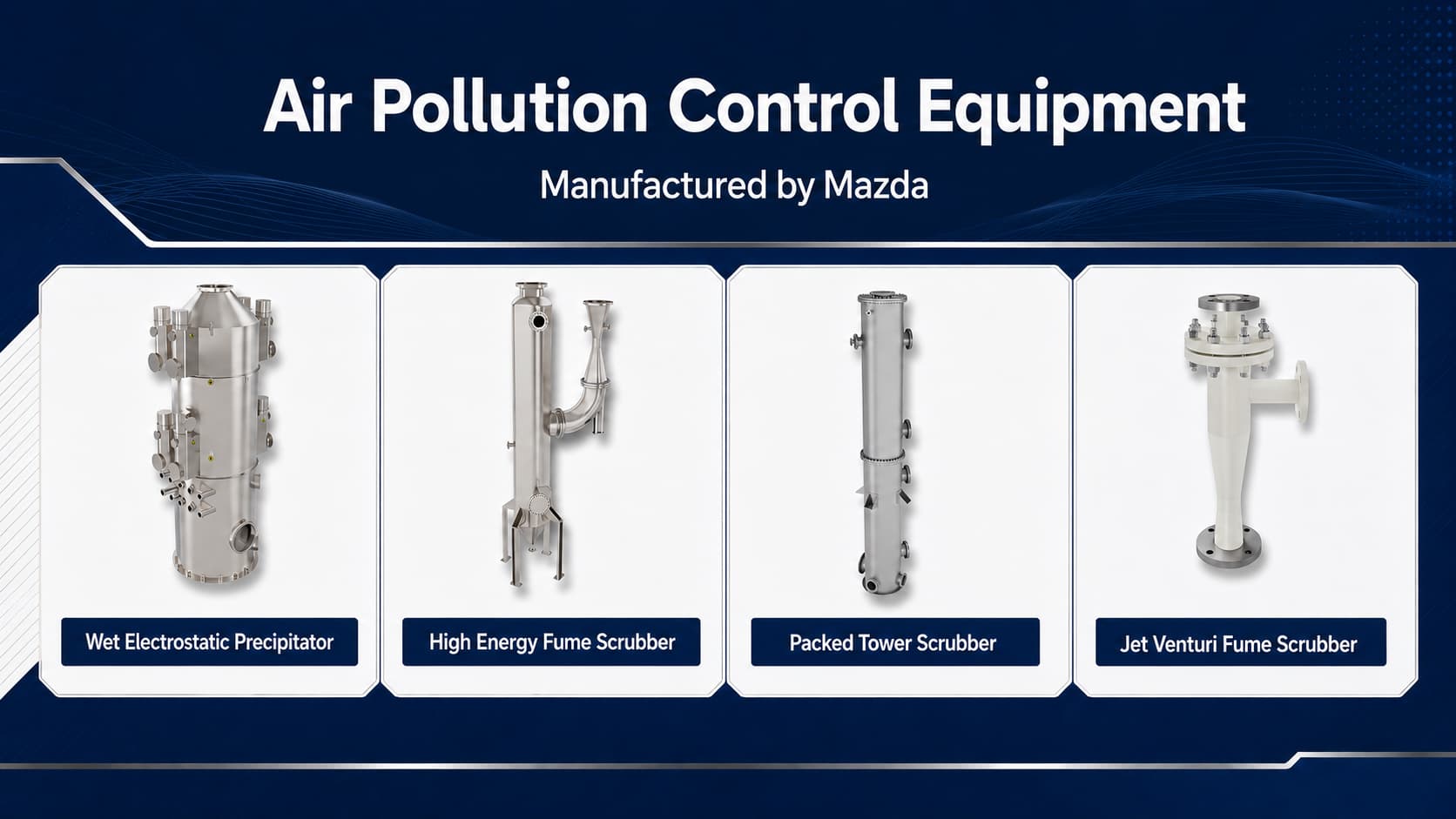
Mazda Limited manufactures four core types of air pollution control equipment, each designed for different gas-cleaning requirements.
A Jet Venturi Fume Scrubber uses the Venturi principle to bring contaminated gas into close contact with a high-velocity scrubbing liquid. The liquid entrains the gas stream and creates intensive gas-liquid contact, allowing particulates, fumes, odors, and selected gaseous contaminants to be captured or absorbed.
The system has no moving parts in the scrubbing section, which helps reduce mechanical maintenance. It can be designed for high-volume contaminated gas streams and demanding process conditions. Depending on the application, construction materials can include fiberglass, stainless steel, or lined metals to provide resistance against corrosive environments.
Jet Venturi Fume Scrubbers are suitable for applications where particulate and gaseous contaminant removal are required within a wet scrubbing system.
A Packed Tower Scrubber is designed primarily for efficient gas absorption through counter-current gas-liquid contact. Contaminated gas flows upward through a packed bed while the scrubbing liquid is distributed from the top and flows downward over the packing.
The packing provides a large surface area for contact between the gas and liquid phases, supporting efficient absorption of suitable gaseous pollutants. Mazda can customize packing types and materials of construction according to process conditions, liquid chemistry, corrosion requirements, and operating parameters.
Packed tower systems can be used for air pollution control and specialized industrial process applications, particularly where gas absorption is an important part of the treatment requirement.
A High Energy Fume Scrubber, also known as a High Energy Venturi Scrubber, is designed for applications requiring efficient removal of fine dust, fumes, and sub-micron particles.
The system uses high-velocity gas flow through a Venturi throat to atomize the scrubbing liquid into fine droplets. Turbulence and particle-droplet interaction enable the system to capture fine contaminants that may be difficult to remove using lower-energy scrubbing systems.
Mazda’s High Energy Fume Scrubbers are available with fixed, variable, or manually adjustable throat configurations to accommodate different operating conditions. Various construction materials can also be selected for corrosive or high-temperature applications.
A WET ESP (Wet Electrostatic Precipitator) is designed for high-efficiency removal of fine particles, mists, aerosols, and sub-micron contaminants from wet or saturated gas streams.
The system uses a high-voltage electrical field to charge fine particles. These charged particles are then attracted to collection surfaces, where they are periodically washed away. This allows the WET ESP to achieve high collection efficiency while maintaining a low pressure drop.
WET ESP systems can be particularly useful as a final-stage or polishing technology after wet scrubbing when very fine particulates, acid mist, or aerosols remain in the treated gas stream.
Our Other Product
Choosing the right air pollution control system requires more than identifying the type of scrubber. Industrial buyers should evaluate the complete process and exhaust conditions before selecting equipment.
Important parameters include:
A general technology-selection approach is:
| Process Requirement | Suitable Equipment |
| Combined particulate, fume and gaseous contaminant removal | Jet Venturi Fume Scrubber |
| Gas absorption through intensive gas-liquid contact | Packed Tower Scrubber |
| Fine and sub-micron particulate or fume removal | High Energy Fume Scrubber |
| Fine mist, aerosol and sub-micron particulate polishing | WET ESP |
In many industrial applications, a combination of technologies may be appropriate. For example, a scrubber can handle bulk contaminants while a WET ESP provides final-stage removal of fine particles or mist. The final configuration should be determined from actual process data and emission requirements.
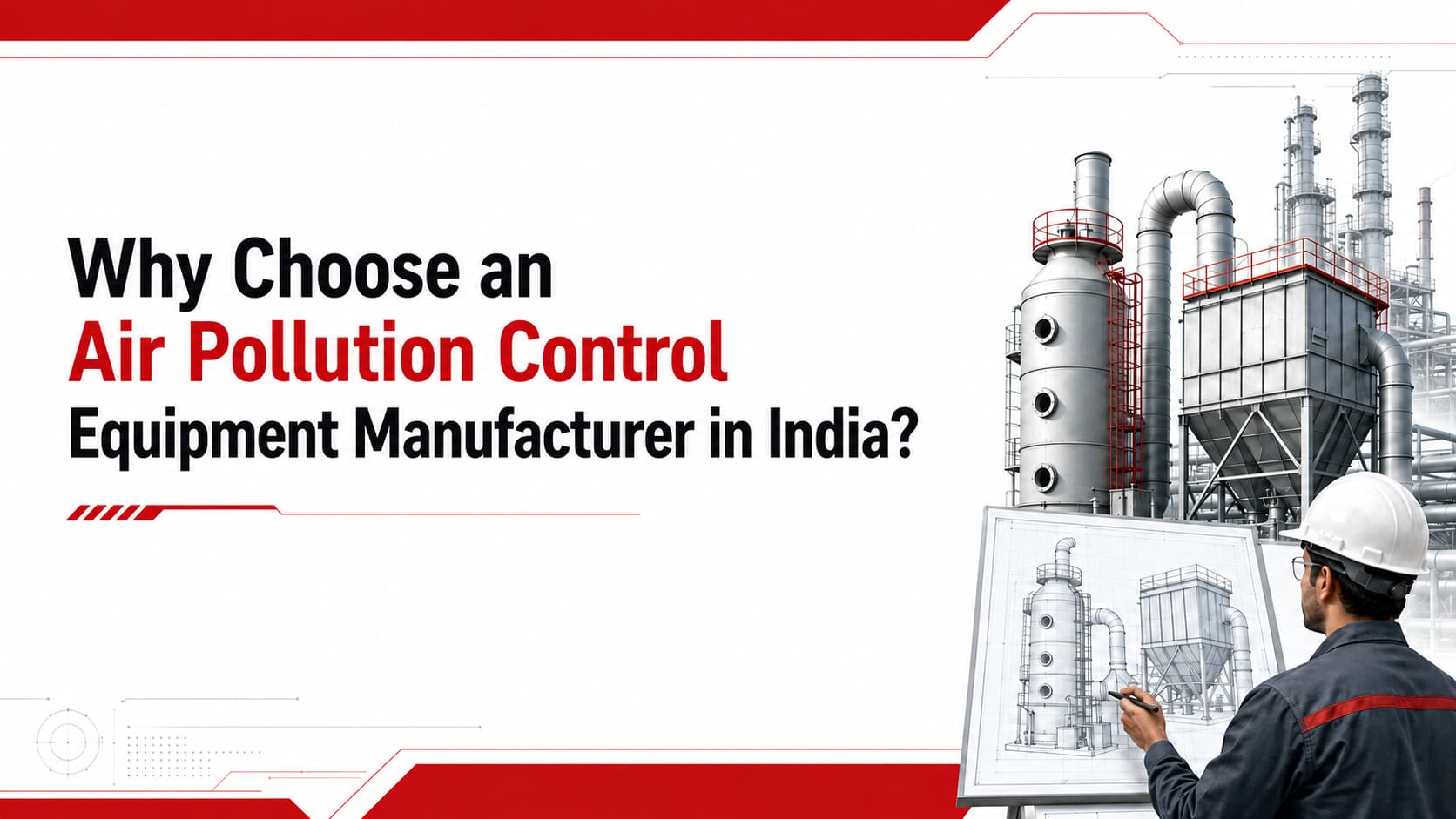
Working directly with an air pollution control equipment manufacturer in India can provide advantages beyond equipment supply. A manufacturer with in-house engineering capabilities can evaluate process conditions, recommend appropriate technology, select materials of construction, and design equipment according to the requirements of the installation.
For industrial buyers, important considerations include:
For complex industrial applications, direct coordination between the manufacturer and the plant’s engineering team can also help ensure that the selected equipment matches the actual gas stream and operating conditions.
Read Our Article
Mazda Limited, established in 1977 and headquartered in Ahmedabad, India, is an engineering and manufacturing company specializing in industrial process equipment. Its capabilities extend across air pollution control, vacuum systems, heat transfer equipment, evaporation and related process technologies.
Mazda operates with certifications including ISO 9001, ISO 14001, and ISO 45001, along with relevant PED, IBR, ASME, and U-Stamp credentials across its engineering and manufacturing operations. The company develops equipment for domestic and international customers and focuses on application-specific engineering, manufacturing quality, and long-term technical support.
Through its Air Pollution Control Division, Mazda manufactures Jet Venturi Fume Scrubbers, Packed Tower Scrubbers, High Energy Fume Scrubbers, and WET ESP systems for industrial emission-control requirements.
Effective air pollution control is essential for industries seeking to manage process emissions, protect equipment, support environmental compliance, and maintain reliable plant operations. Because industrial exhaust streams can contain different combinations of gases, fumes, particulates, mists, and aerosols, selecting the right technology is critical.
As an air pollution control equipment manufacturer in India, Mazda Limited offers four core technologies — Jet Venturi Fume Scrubbers, Packed Tower Scrubbers, High Energy Fume Scrubbers, and WET ESP systems. Each technology addresses different emission-control requirements and can be considered according to the process conditions and treatment objectives.
Looking for an air pollution control equipment manufacturer or supplier in India? Contact Mazda Limited to discuss your industrial emission-control requirements and identify the appropriate scrubbing or WET ESP technology for your application.
Our Other Product
Air pollution control equipment is used to remove or reduce pollutants such as dust, fumes, gases, mists, aerosols, and fine particulate matter from industrial gas streams before discharge. The appropriate equipment depends on the type of pollutant, gas conditions, required removal efficiency, and process requirements.
Mazda Limited manufactures four core types of air pollution control equipment: Jet Venturi Fume Scrubbers, Packed Tower Scrubbers, High Energy Fume Scrubbers, and Wet Electrostatic Precipitators (WET ESP). Each technology is designed for different gas-cleaning and emission-control requirements.
A Jet Venturi Fume Scrubber is used for applications requiring removal of particulates, fumes, odors, and selected gaseous contaminants. It uses high-velocity scrubbing liquid to create intensive gas-liquid contact and can be designed for high-volume contaminated gas streams.
A Packed Tower Scrubber is a gas absorption system in which contaminated gas flows upward through a packed bed while scrubbing liquid flows downward. The resulting large gas-liquid contact area supports efficient absorption of suitable gaseous pollutants.
A High Energy Fume Scrubber, also called a High Energy Venturi Scrubber, is designed for efficient removal of fine dust, fumes, and sub-micron particles. It uses high-velocity gas flow and fine scrubbing-liquid droplets to improve particle capture.
A WET ESP, or Wet Electrostatic Precipitator, uses a high-voltage electrical field to capture fine particles, mists, aerosols, and sub-micron contaminants from wet or saturated gas streams. It can also be used as a final-stage polishing system after wet scrubbing.
Selection should be based on factors including pollutant type and concentration, gas composition, flow rate, particle size, temperature, moisture content, required removal efficiency, corrosiveness, pressure-drop limitations, utility availability, installation space, and existing pollution-control equipment.
A High Energy Fume Scrubber can be considered for fine and sub-micron particulate or fume removal, while a WET ESP can provide high-efficiency collection of fine particles, mists, aerosols, and sub-micron contaminants. The appropriate technology depends on the actual process and emission characteristics.
Yes. In some industrial applications, multiple technologies can be combined. For example, a scrubber may handle bulk contaminants while a WET ESP provides final-stage removal of fine particles or mist. The final configuration should be determined from actual process data and emission requirements.
Working directly with a manufacturer can provide access to application-specific engineering, customized sizing and configuration, material selection, system integration, technical assistance, and after-sales support. These capabilities are particularly useful when equipment must be designed around specific gas streams and plant conditions.
Air pollution control equipment can be used in chemical processing, fertilizer manufacturing, metallurgical and steel processing, pharmaceutical manufacturing, and other industrial process-exhaust applications. The appropriate technology depends on the pollutants and operating conditions of the individual process.
Yes. Mazda Limited is an air pollution control equipment manufacturer and supplier in India, with its Air Pollution Control Division offering Jet Venturi Fume Scrubbers, Packed Tower Scrubbers, High Energy Fume Scrubbers, and WET ESP systems. The company was established in 1977 and is headquartered in Ahmedabad, India.




Our team is available to provide professional support and will respond promptly to any inquiries or assistance you need.