


Read Our Article
Vacuum Pump Manufacturer in India: Types of Industrial Vacuum Pumps & Systems
Mazda Limited is an established Indian manufacturer of industrial process equipment, offering engineered solutions for diverse industrial applications. Its portfolio covers vacuum systems, heat transfer equipment, evaporation, crystallization, drying, air pollution control, and non-chemical water treatment. Key products include steam jet ejectors, liquid ring vacuum pumps, condensers, HP/LP heaters, MEE, TVR and MVR evaporators, OSLO crystallizers, ATFDs, solvent stripping units, fume scrubbers, WET ESP systems, and Smart Rod Systems. Established in 1977, Mazda emphasizes application-specific engineering, manufacturing, customization, quality certifications, and technical support for industries including power, chemicals, pharmaceuticals, refining, food processing, steel, and water treatment.
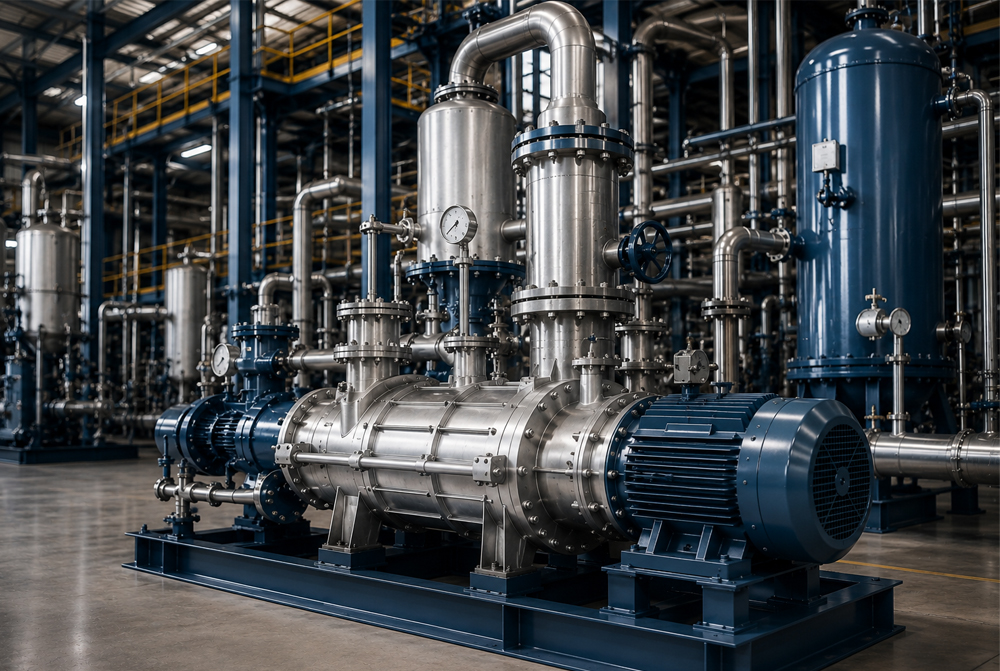
Industrial processes depend on reliable equipment to control pressure, temperature, flow, heat, evaporation, condensation, separation, emissions, and water quality. From vacuum systems used in distillation and drying to evaporators for liquid concentration, condensers for power plants, scrubbers for emission control, and non-chemical water treatment systems, the right process equipment can have a direct impact on plant efficiency, operating costs, reliability, and environmental performance.
Mazda Limited is an industrial process equipment manufacturer and supplier in India, offering a broad portfolio of engineered equipment and systems for industrial and process applications. Established in 1977, Mazda has developed expertise across vacuum technology, heat transfer, evaporation and crystallization, air pollution control, and non-chemical water treatment.
Rather than offering a single standard equipment configuration, Mazda develops solutions according to application-specific requirements such as pressure, temperature, flow rate, process media, gas or liquid characteristics, energy availability, and installation conditions. Its portfolio includes steam jet ejectors, liquid ring vacuum pumps, condensers, HP and LP heaters, MEE/TVR/MVR evaporators, crystallizers, dryers, fume scrubbers, WET ESP systems, and Smart Rod Systems.
This broad manufacturing capability allows industrial buyers to source different process technologies from an experienced engineering organization while selecting equipment according to their individual plant and process requirements.
Industrial process equipment refers to the machinery, systems, and engineered components used to perform or support specific operations within a manufacturing or processing plant. Depending on the industry, this can include equipment for heating, cooling, evaporation, condensation, vacuum generation, separation, drying, crystallization, emission control, and water treatment.
Process equipment is commonly integrated into larger production systems rather than operating independently. For example, a vacuum system may support an evaporator, a surface condenser may form part of a turbine steam cycle, or a scrubber may be installed downstream of a process exhaust to remove pollutants before discharge.
The correct equipment depends on the specific operating conditions. Factors such as pressure, temperature, flow rate, viscosity, chemical composition, vapor load, particulate characteristics, utility availability, energy costs, and required process performance all influence equipment selection.
For this reason, industrial buyers generally need more than a standard catalogue product. Application-specific engineering, material selection, equipment sizing, and system integration can be important when designing equipment for demanding industrial environments.
The performance of process equipment can directly influence a plant’s productivity, energy consumption, maintenance requirements, and operating costs. Equipment that is incorrectly sized or poorly matched to the process can lead to inefficient operation, higher utility consumption, reduced reliability, and increased maintenance.
Selecting the right industrial process equipment can help plants:
The requirement can vary significantly between industries. A chemical plant may require vacuum and evaporation equipment, a power plant may need condensers and feedwater heaters, while a process facility dealing with industrial emissions may require scrubbers or a WET ESP.
Therefore, industrial process equipment selection should begin with the process requirement rather than the equipment name alone.
Mazda Limited manufactures and supplies equipment across several industrial process technology categories. Each category addresses a different stage or requirement within industrial operations.
Vacuum technology is used in processes where pressure below atmospheric conditions is required. By reducing pressure, vacuum systems can lower the boiling point of liquids and support processes such as distillation, evaporation, drying, solvent recovery, degassing, and steam condensation.
Mazda’s vacuum equipment portfolio includes mechanical, steam-operated, and hybrid vacuum technologies.
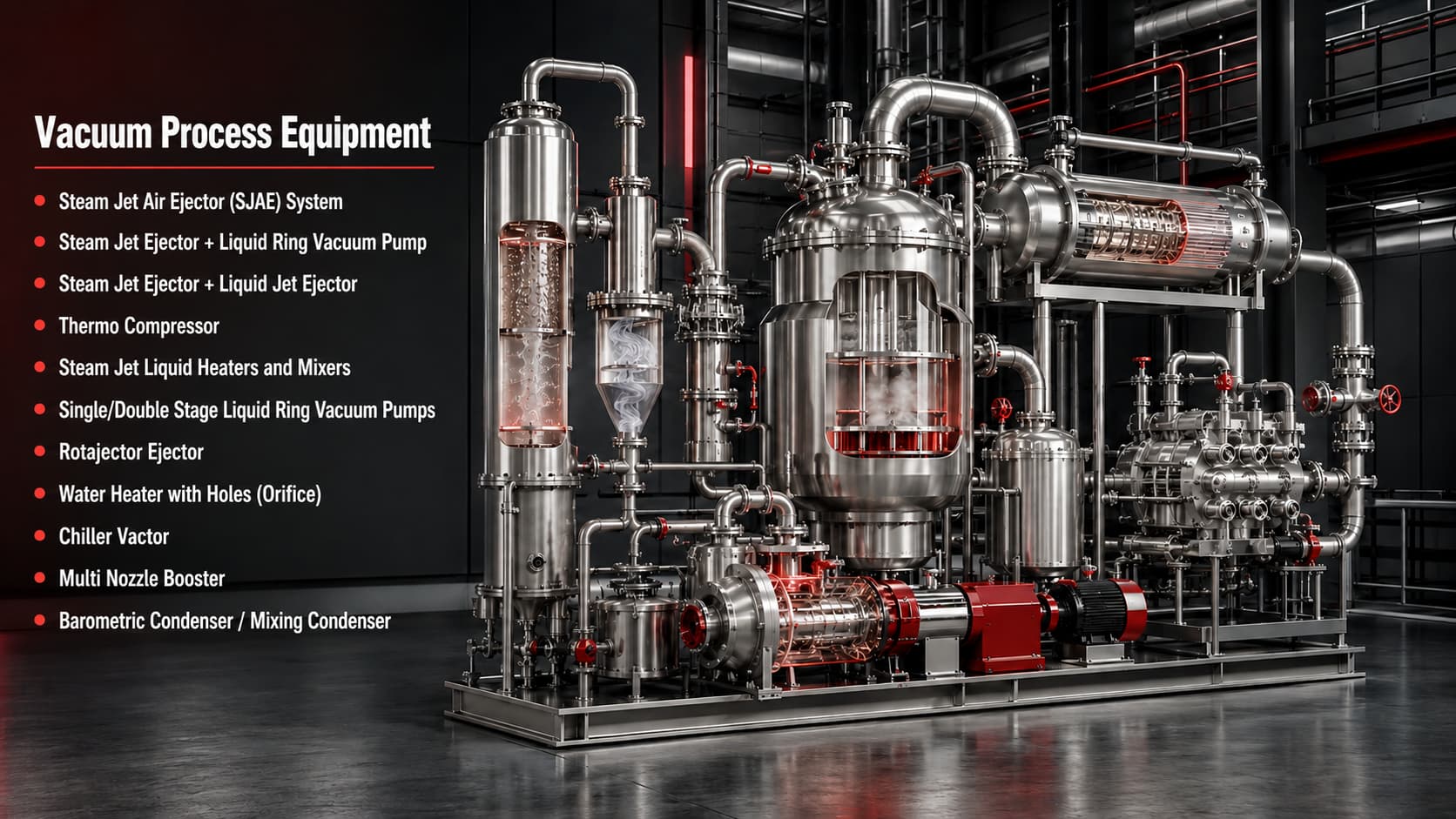
Uses high-pressure steam to remove air and non-condensable gases and generate vacuum. Steam jet ejectors are suitable for applications requiring reliable vacuum without conventional rotating equipment.
Combines steam ejector technology with a mechanical liquid ring vacuum pump to provide stable vacuum generation under varying process loads.
Uses steam and liquid jet ejector technologies in combination to achieve the required vacuum performance while providing flexibility in system configuration.
Recompresses low-pressure steam to a higher usable pressure, improving steam utilization and supporting energy-efficient process operations.
Use direct steam injection for rapid and uniform liquid heating and mixing, with a simple design and no moving parts.
Mechanical vacuum pumps designed for reliable operation, higher vacuum capability, and reduced power consumption in suitable industrial applications.
A hybrid vacuum technology combining the operating principle of a steam jet ejector with a rotating assembly to provide high suction capacity with reduced steam consumption.
Uses direct steam injection to provide rapid and uniform heating of liquids.
A multi-ejector-based evaporative cooling system designed to produce chilled water without conventional hazardous refrigerants.
Uses multiple nozzles to improve steam utilization and can reduce steam consumption compared with conventional single-nozzle booster designs.
Uses direct-contact steam condensation to support vacuum generation and can eliminate the need for condensate pumps through a barometric leg arrangement.
Together, these products allow Mazda to address different vacuum, steam, heating, cooling, and condensation requirements rather than relying on a single vacuum technology.
Heat transfer equipment is essential wherever thermal energy needs to be transferred, recovered, condensed, or reused within a process. In power generation, for example, condensers and feedwater heaters form important parts of the steam-water cycle.
Mazda’s heat transfer range includes:
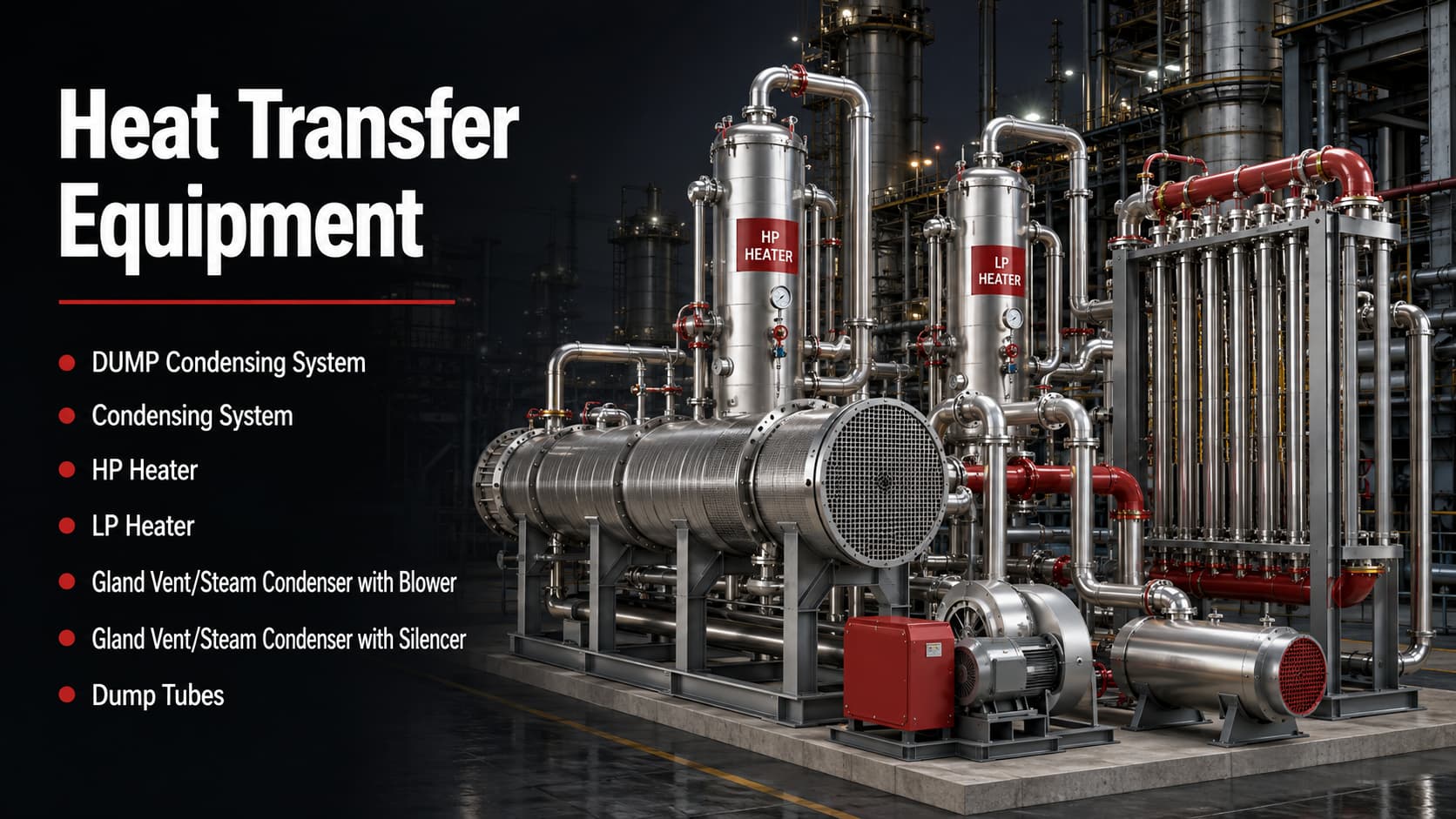
A Dump Condensing System handles excess steam during turbine trips, startup, shutdown, bypass conditions, or sudden load changes. Instead of allowing excess steam to be vented, the system condenses it and allows the recovered condensate to be managed within the plant.
Mazda’s Condensing Systems are engineered packages incorporating surface condensers and related vacuum and auxiliary equipment. They are designed to condense turbine exhaust steam while maintaining suitable vacuum conditions.
High Pressure (HP) Heaters use extraction steam to preheat boiler feedwater at the high-pressure stages of a power plant’s steam cycle, supporting improved thermal efficiency.
Low Pressure (LP) Heaters use lower-pressure extraction steam to preheat feedwater at earlier stages of the feedwater cycle.
The Gland Vent / Steam Condenser with Blower handles steam and non-condensable gases associated with turbine gland sealing systems and uses a blower-based extraction arrangement.
The Gland Vent / Steam Condenser with Silencer configuration provides gland steam condensation with a silencer-based vent arrangement, depending on the plant’s operating and installation requirements.
Dump Tubes are used in steam bypass and dump applications to condition steam before it enters the condenser, helping manage demanding operating conditions.
Mazda’s heat transfer equipment can therefore support steam condensation, feedwater heating, heat recovery, gland steam management, and turbine-cycle operations.
Evaporation and crystallization equipment is used to concentrate process liquids, recover valuable materials, reduce wastewater volume, and support zero liquid discharge processes. Drying equipment can be used for highly concentrated or high-viscosity streams that require further moisture removal.
Mazda’s range includes six key technologies.
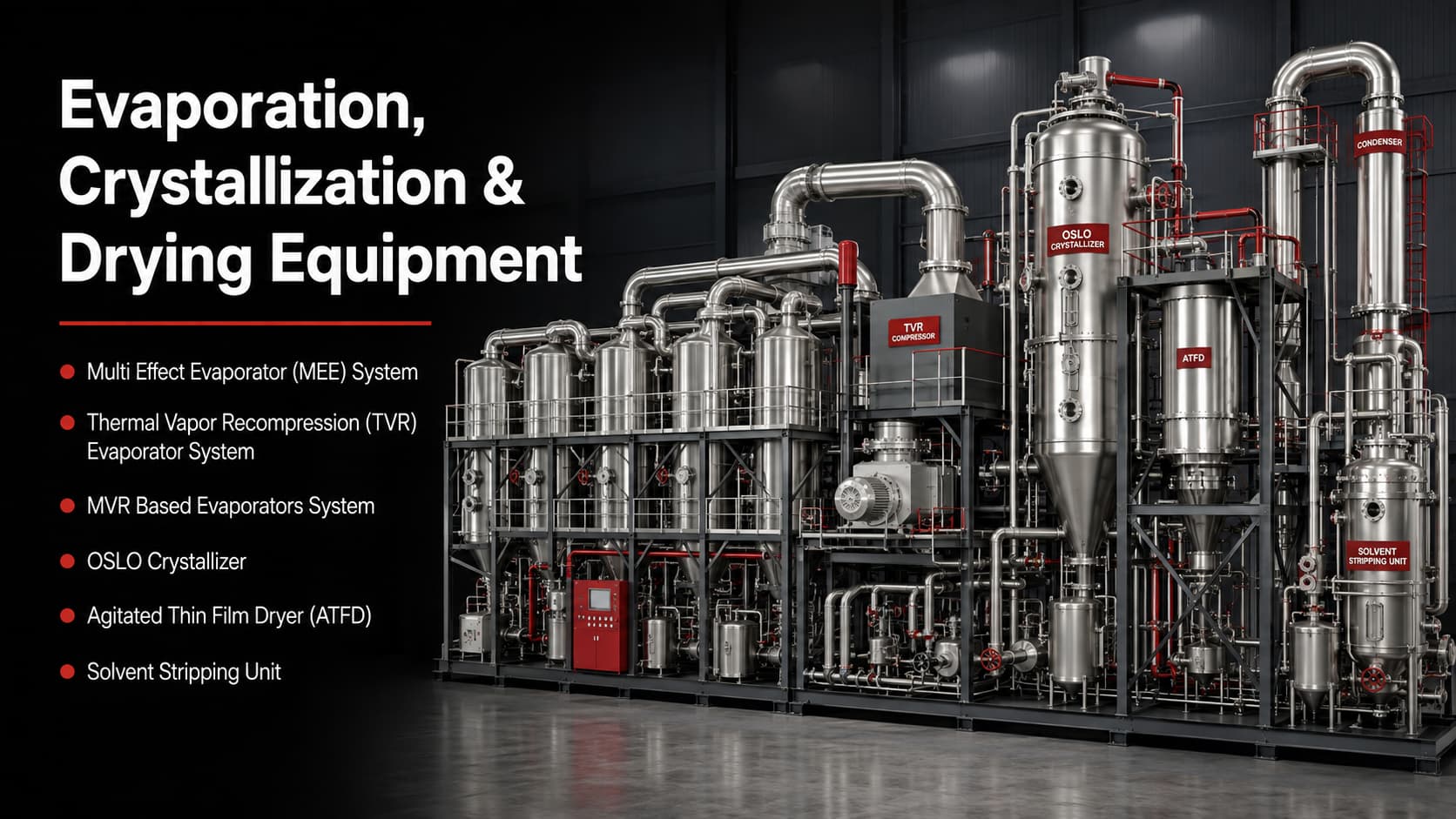
A Multi Effect Evaporator reuses vapor generated in one evaporation stage as the heating medium for the next stage. This multi-stage arrangement reduces fresh steam consumption and provides energy-efficient concentration of process liquids.
A TVR Evaporator uses motive steam through a thermo compressor to recompress part of the generated vapor and reuse it as heating vapor. It can reduce live steam demand while providing a relatively simple evaporation configuration.
A Mechanical Vapor Recompression (MVR) Evaporator mechanically compresses generated vapor and reuses it as the heating medium. This can significantly reduce dependence on fresh steam and is particularly relevant where energy economics favor electrical power over continuous steam consumption.
The OSLO Crystallizer, also known as a classified-suspension crystallizer, is designed to produce large, coarse crystals with controlled and relatively narrow size distribution. Its fluidized crystal bed supports controlled crystal growth while minimizing mechanical crystal breakage.
An Agitated Thin Film Dryer is designed to process concentrated, high-viscosity, or heat-sensitive slurries. The feed forms a thin film over a heated surface, allowing rapid evaporation and leaving behind dry solids, powders, or flakes. ATFD systems are commonly relevant to Zero Liquid Discharge (ZLD) applications.
A Solvent Stripping Unit uses steam stripping and vacuum distillation to separate and recover solvents from industrial wastewater and process streams, supporting solvent recovery and waste reduction.
These technologies can also be combined into integrated process trains where concentration, crystallization, drying, and recovery are required as successive stages.
Industrial processes can generate dust, fumes, acid gases, aerosols, mists, and other contaminants. Air pollution control equipment is designed to treat contaminated gas streams before discharge and help plants achieve their required emission-control performance.
Mazda’s Air Pollution Control Division includes four core technologies.
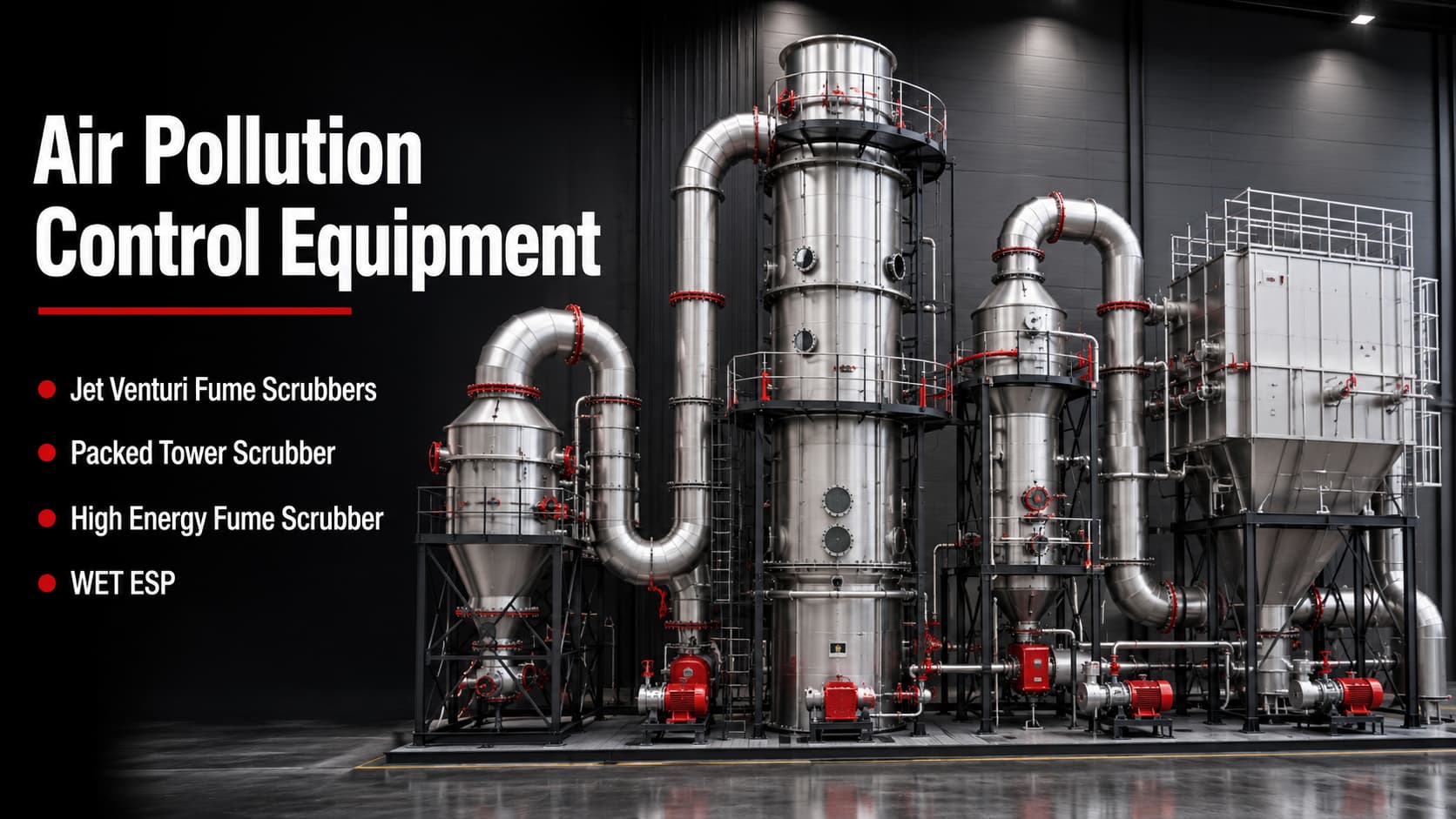
The Jet Venturi Fume Scrubber uses high-velocity liquid injection to create intensive gas-liquid contact. It can remove particulates, fumes, odors, and suitable gaseous contaminants from industrial gas streams.
A Packed Tower Scrubber uses counter-current gas-liquid contact through a packed bed. The large contact surface promotes absorption of suitable gaseous pollutants and makes the technology useful for air pollution control and specialized process applications.
The High Energy Fume Scrubber uses a high-energy Venturi arrangement to capture fine dust, fumes, and sub-micron particles. Different throat configurations can be considered for varying gas-flow conditions.
A Wet Electrostatic Precipitator (WET ESP) uses a high-voltage electrical field to capture fine particulates, mists, aerosols, and acid mist from wet or saturated gas streams. It can also serve as a polishing stage after wet scrubbing where very fine particulate removal is required.
The selection of air pollution control technology depends on the pollutant type, particle size, gas composition, flow rate, temperature, moisture content, and required removal efficiency.
In addition to conventional process equipment, Mazda offers the Smart Rod System, a non-chemical technology designed to help control scale formation and biological fouling in water systems.
The Smart Rod System uses high-pulsating DC voltage to enhance the zeta potential of suspended particles. By increasing particle repulsion, the system helps keep particles suspended rather than allowing them to accumulate on surfaces.
The system can be applied to:
With no moving parts and very low power consumption, the Smart Rod System is designed to provide an alternative approach to managing scale and biofouling while reducing dependence on chemicals and frequent cleaning.
Industrial buyers may know the problem they need to solve but not necessarily the equipment category required. A basic application-to-technology guide can help:
| Industrial Requirement | Mazda Product Range |
| Vacuum for distillation, drying or evaporation | Vacuum Process Equipment |
| Air and non-condensable gas removal | Steam Jet Air Ejector |
| Mechanical vacuum generation | Liquid Ring Vacuum Pumps |
| Turbine steam condensation | Condensing System |
| Feedwater preheating | HP / LP Heaters |
| Excess steam during turbine trip or startup | Dump Condensing System |
| Liquid concentration | MEE / TVR / MVR Evaporators |
| Crystalline product recovery | OSLO Crystallizer |
| High-viscosity slurry drying | ATFD |
| Solvent recovery | Solvent Stripping Unit |
| Industrial particulate and fume removal | Jet Venturi / High Energy Scrubbers |
| Gas absorption | Packed Tower Scrubber |
| Fine particulate, mist and aerosol removal | WET ESP |
| Scale and biofouling control without chemicals | Smart Rod System |
This table should be considered a starting point. Final equipment selection requires evaluation of the actual process conditions and operating requirements.
Industrial process equipment is used across many sectors, with different technologies serving different process stages.
Vacuum systems, surface condensers, gland steam condensers, dump condensing systems, HP heaters, LP heaters, and other heat transfer equipment support turbine and steam-cycle operations.
Vacuum systems, evaporators, crystallizers, dryers, solvent recovery systems, heaters, and air pollution control equipment can support a wide range of chemical processing requirements.
Vacuum, evaporation, drying, crystallization, solvent recovery, and process heating technologies can support applications where controlled temperature and pressure conditions are important.
Vacuum systems, heat transfer equipment, condensers, and emission-control technologies can be used in various refining and process operations.
Process vacuum, evaporation, heat transfer, and air pollution control technologies can support different production and environmental-control requirements.
Vacuum, heating, evaporation, concentration, and process water technologies can be relevant to food and beverage processing applications where controlled thermal conditions are required.
Vacuum and heat transfer systems can support processes such as controlled heating, evaporation, and vacuum-based refining operations.
Air pollution control systems can be used to manage dust, fumes, particulates, and other contaminants generated by industrial processes.
Evaporation, crystallization, drying, solvent recovery, and non-chemical water treatment technologies can support water recovery, wastewater minimization, and treatment objectives.
The exact equipment and configuration should always be determined according to the specific process, plant capacity, operating conditions, and treatment requirements.
Read Our Article
Choosing a process equipment supplier is an important decision for industrial buyers because equipment often operates continuously and becomes an integral part of the plant.
Key factors to evaluate include:
The manufacturer should be able to understand the process conditions and translate them into appropriate equipment specifications.
In-house manufacturing can provide greater control over fabrication, materials, quality, and production requirements.
A manufacturer with experience across multiple process technologies can help evaluate different equipment options rather than recommending one technology for every requirement.
Industrial equipment may need to accommodate specific pressures, temperatures, capacities, materials, space limitations, or existing plant configurations.
Relevant quality and engineering certifications can provide assurance regarding manufacturing and design practices.
Equipment selection is only one part of a successful project. Technical assistance, commissioning support, maintenance guidance, and after-sales service can also be important over the equipment’s operating life.
Mazda Limited brings together engineering, manufacturing, and process technology expertise across multiple industrial equipment categories.
Established in 1977, the company has developed capabilities spanning vacuum systems, heat transfer equipment, evaporation and crystallization systems, air pollution control equipment, and non-chemical water treatment.
For industrial buyers, this broad portfolio offers the advantage of working with one engineering organization across different process requirements. Mazda can evaluate the application, equipment technology, operating conditions, materials, and integration requirements to develop an appropriate configuration.
The company also maintains certifications including ISO 9001, ISO 14001, and ISO 45001, along with relevant PED, IBR, ASME, and U-Stamp credentials across its operations.
With domestic and international project experience, Mazda serves industrial customers requiring engineered equipment and technical support for both new installations and selected existing-plant requirements.
Industrial process equipment refers to machinery and engineered systems used to perform operations such as heating, cooling, evaporation, condensation, vacuum generation, separation, drying, crystallization, emission control, and water treatment within industrial plants.
Mazda manufactures equipment across five major areas: vacuum process equipment, heat transfer equipment, evaporation/crystallization/drying equipment, air pollution control equipment, and non-chemical water treatment systems.
Yes. Mazda's equipment is engineered according to application-specific requirements such as pressure, temperature, flow rate, process media, gas or vapor characteristics, materials, and installation conditions.
Mazda's technologies can support applications in power generation, chemical and process industries, pharmaceuticals, petroleum refining, petrochemicals, fertilizers, food and beverage processing, edible oil refining, steel and metallurgy, and water and wastewater treatment, depending on the specific equipment and process.
Start with the process requirement and define parameters such as capacity, pressure, temperature, flow rate, process composition, utility availability, energy costs, required performance, and installation conditions. A qualified manufacturer can then recommend the appropriate technology.
Depending on the equipment and application, Mazda can engineer equipment for integration into existing systems, replacement requirements, capacity changes, and plant-specific installation conditions.
Mazda's portfolio includes both individual equipment and integrated systems. Depending on the application, equipment such as vacuum systems, condensers, evaporators, crystallizers, dryers, scrubbers, and auxiliary components can be supplied as standalone units or integrated into broader process systems.
Industrial process equipment is fundamental to the performance, efficiency, reliability, and environmental management of modern manufacturing and processing plants. From creating vacuum and transferring heat to concentrating liquids, recovering solvents, controlling emissions, and managing water systems, each process requirement calls for an appropriately engineered technology.
Mazda Limited offers a comprehensive range of industrial process equipment and systems, covering vacuum, heat transfer, evaporation and crystallization, drying, air pollution control, and non-chemical water treatment. Its portfolio includes technologies such as steam jet ejectors, liquid ring vacuum pumps, condensers, HP/LP heaters, MEE, TVR and MVR evaporators, OSLO crystallizers, ATFDs, solvent stripping units, fume scrubbers, WET ESP, and Smart Rod Systems.
For B2B buyers, selecting equipment based on actual process conditions is essential. Working with an experienced industrial process equipment manufacturer in India can help ensure that the selected technology is appropriately designed, manufactured, and integrated for the intended application.
Looking for an industrial process equipment manufacturer or supplier in India? Contact Mazda Limited to discuss your process requirements and identify the right equipment or integrated system for your application.



Our team is available to provide professional support and will respond promptly to any inquiries or assistance you need.