

Read Our Article
Read AI-Generated Summary:
Mazda Limited is an Indian vacuum pump manufacturer offering industrial vacuum pumps and systems for applications such as distillation, evaporation, drying, condensation, degassing, and solvent recovery. Its product range includes single and double-stage liquid ring vacuum pumps, Steam Jet Air Ejectors (SJAE), steam jet ejector–liquid ring pump combinations, steam jet–liquid jet ejector systems, and Rotajector ejectors. Supporting equipment includes thermo compressors, multi-nozzle boosters, and barometric condensers. Equipment selection depends on vacuum level, suction capacity, process gases and vapors, temperature, utilities, energy consumption, and operating conditions. Established in 1977, Mazda provides engineered vacuum solutions for domestic and international industries.
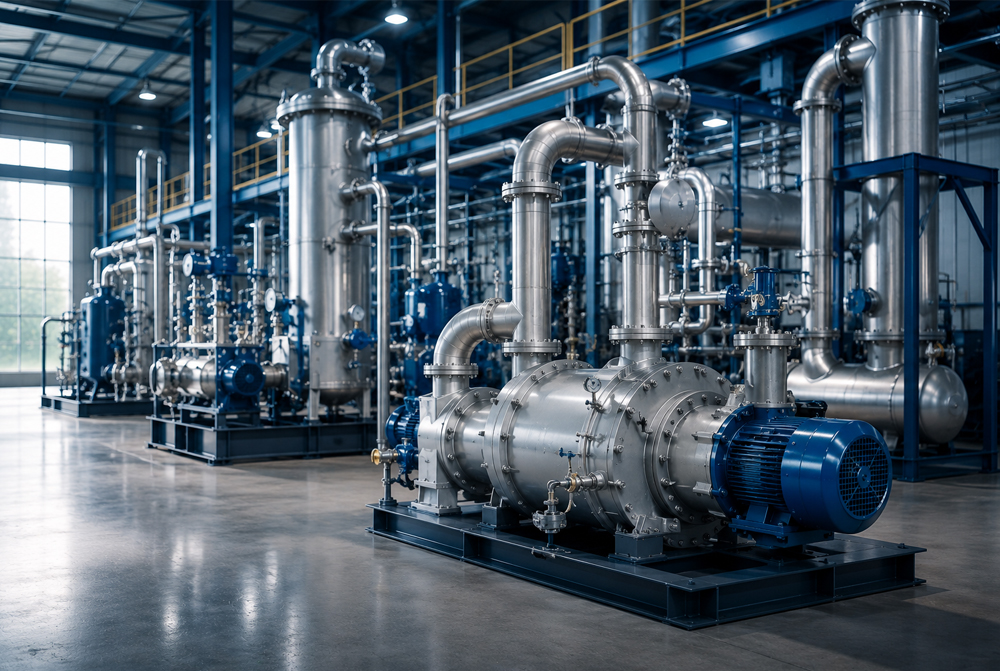
Industrial vacuum technology plays an important role in processes where pressure below atmospheric conditions is required for efficient separation, evaporation, drying, condensation, degassing, or material handling. The right vacuum equipment can improve process performance, reduce energy consumption, and maintain stable operating conditions.
Mazda Limited is a vacuum pump manufacturer and industrial vacuum equipment supplier in India, with engineering and manufacturing experience dating back to 1977. The company supplies different vacuum-generation technologies, including liquid ring vacuum pumps, steam jet air ejectors, combination vacuum systems, and hybrid ejector technologies. These systems are engineered according to process requirements such as vacuum level, suction capacity, gas and vapor load, operating temperature, and available utilities.
Rather than relying on one type of vacuum equipment for every application, industrial buyers can select from different technologies depending on the required vacuum performance and operating conditions. Mazda’s range includes single and double stage liquid ring vacuum pumps, Steam Jet Air Ejector (SJAE) systems, steam jet ejector and liquid ring vacuum pump combination systems, steam jet and liquid jet ejector systems, and Rotajector ejectors.
Email Us for a Quick Response
What Is an Industrial Vacuum Pump?
An industrial vacuum pump or vacuum system removes air, gases, vapors, or other non-condensable gases from an enclosed process system to create pressure below atmospheric pressure. Depending on the technology, vacuum can be generated mechanically, thermodynamically, or through a combination of methods.
Vacuum is widely used because reducing pressure can lower the boiling temperature of liquids. This makes vacuum particularly useful for distillation, evaporation, drying, solvent recovery, degassing, steam condensation, and other temperature-sensitive industrial processes.
Selecting a vacuum pump is not simply a matter of choosing the highest possible vacuum level. Buyers also need to consider suction capacity, gas composition, condensable vapor load, operating temperature, available steam and cooling water, electricity consumption, process fluctuations, and installation conditions.
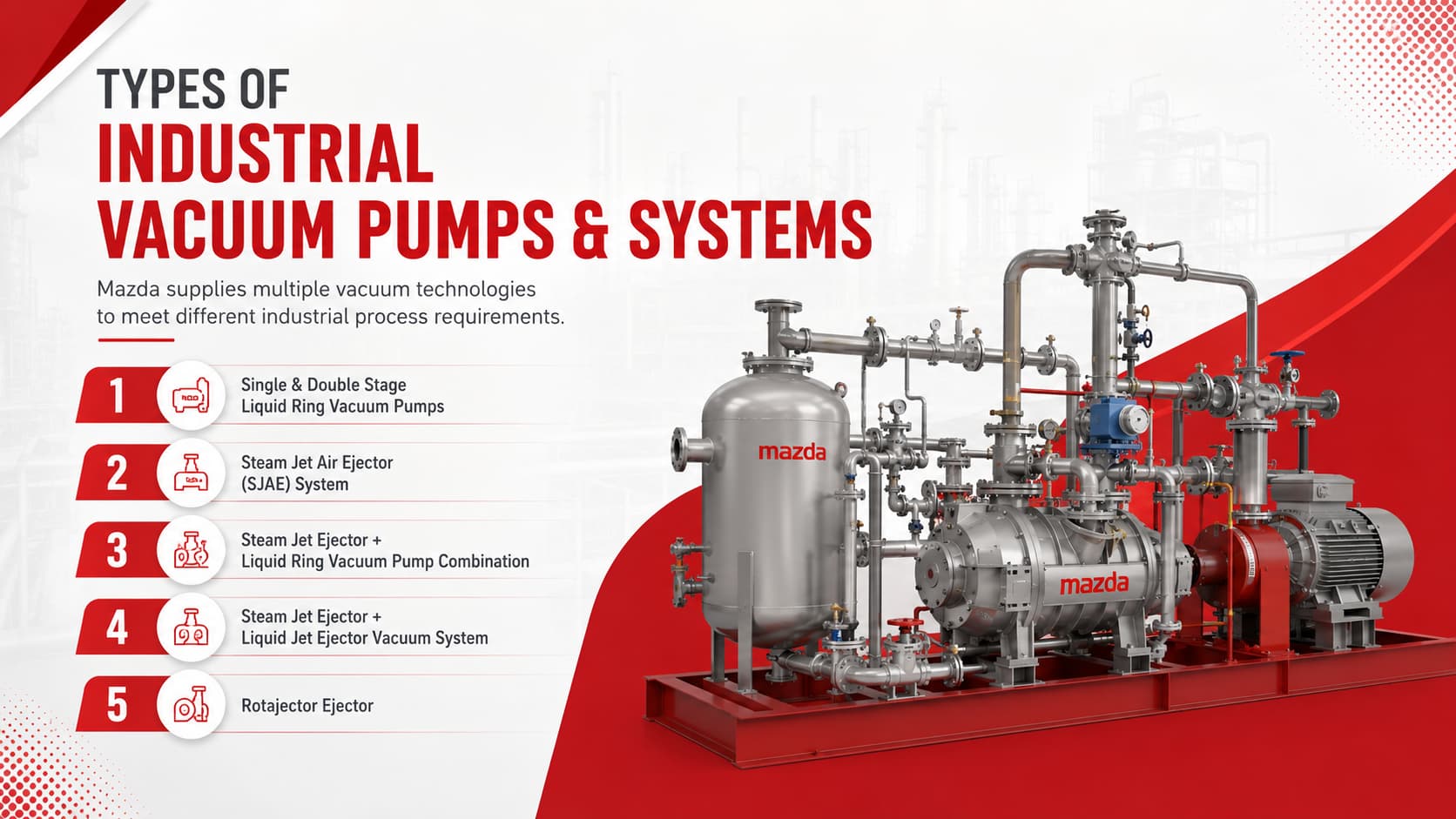
Types of Industrial Vacuum Pumps & Systems
Mazda supplies multiple vacuum technologies to meet different industrial process requirements.
1. Single & Double Stage Liquid Ring Vacuum Pumps
Liquid ring vacuum pumps are mechanical vacuum pumps designed for continuous industrial operation. Mazda’s single and double stage liquid ring vacuum pumps are engineered to provide reliable vacuum generation with efficient operation and reduced power consumption.
The two-stage configuration can provide higher vacuum capability and capacity compared with conventional arrangements, while the robust construction supports demanding industrial environments. Liquid ring technology can also handle gases and vapors in applications where mechanical vacuum generation is preferred.
Mazda’s liquid ring vacuum pumps can be combined with air ejectors where lower suction pressures are required. This combination can help improve vacuum stability and protect against operating conditions such as cavitation.
For industrial buyers looking for a liquid ring vacuum pump manufacturer in India, selection should be based on required vacuum, capacity, process gas characteristics, liquid compatibility, and operating conditions.
2. Steam Jet Air Ejector (SJAE) System
A Steam Jet Air Ejector (SJAE) is a steam-operated vacuum-generation system that uses high-pressure motive steam rather than a conventional rotating mechanical pump. High-velocity steam passing through a nozzle creates suction, drawing air and non-condensable gases from the process equipment.
One of the major advantages of steam jet ejectors is their simple construction with no conventional moving parts in the ejector itself. This can result in low maintenance requirements and reliable operation in demanding industrial applications.
SJAE systems can be designed as single-stage or multi-stage configurations and can be integrated with condensers or other vacuum equipment. They are commonly relevant to processes involving distillation, evaporation, drying, condensation, and removal of non-condensable gases.
For applications where steam is readily available and high vacuum performance is required, a steam jet vacuum system can be an effective alternative to purely mechanical vacuum generation.
3. Steam Jet Ejector + Liquid Ring Vacuum Pump Combination
Some industrial processes experience varying vacuum loads or require a combination of deep vacuum capability and stable continuous operation. Mazda’s combination vacuum system of steam jet ejector and liquid ring vacuum pump brings these technologies together.
The steam jet ejector can provide strong suction and vacuum generation, while the liquid ring vacuum pump supports continuous mechanical evacuation. Combining the two technologies can provide greater flexibility under variable process conditions and help balance steam and electrical energy requirements.
These systems can be engineered according to the required vacuum level, suction capacity, process load, and available utilities. They are particularly relevant for industrial plants where operating conditions change during different stages of production.
4. Steam Jet Ejector + Liquid Jet Ejector Vacuum System
Mazda also supplies combination vacuum systems using steam jet ejectors and liquid jet ejectors. This technology combines two ejector principles to generate vacuum without relying exclusively on a mechanical vacuum pump.
Steam and liquid jet stages can be configured to achieve the required vacuum performance while considering steam and water consumption, installation conditions, and process requirements. Such systems can be particularly useful where a hybrid vacuum arrangement is preferred.
The configuration can also offer installation flexibility, including applications where equipment needs to be installed at ground level. As with other vacuum systems, the final arrangement should be selected based on the process gas load, required vacuum, utilities, and site conditions.
5. Rotajector Ejector
The Rotajector Ejector is a hybrid vacuum technology that combines the operating principle of a steam jet ejector with a rotating assembly.
This design aims to retain the high suction capacity and reliability associated with ejector systems while improving efficiency and reducing steam consumption through rotary assistance. Its compact and rugged design makes it suitable for continuous-duty industrial applications where dependable vacuum generation and energy efficiency are important.
For plants looking for an alternative to conventional ejector-only configurations, the Rotajector provides another approach to industrial vacuum generation.
Our Other Product
Supporting Equipment for Industrial Vacuum Systems
A complete vacuum installation can include more than the primary vacuum pump or ejector. Supporting equipment can influence overall system efficiency, steam consumption, condensation, and operating stability.
Thermo Compressor
A thermo compressor uses high-pressure motive steam to entrain and recompress lower-pressure steam, allowing it to be reused at a higher pressure. This can improve steam utilization and reduce operating costs in applications such as evaporation, desalination, and process heating.
Multi Nozzle Booster
Mazda’s Multi Nozzle Booster uses multiple nozzles to improve steam utilization. The company’s product information states that the design can achieve the same motive and suction pressure with 15–20% lower steam consumption than conventional single-nozzle booster designs.
Barometric / Mixing Condenser
A Barometric Condenser, also known as a mixing or contact condenser, uses direct contact between cooling water and steam to achieve rapid condensation and support vacuum generation. Its barometric leg design can eliminate the need for mechanical condensate pumps in suitable installations.
These components can be incorporated into broader vacuum and steam-cycle systems depending on the process requirements.
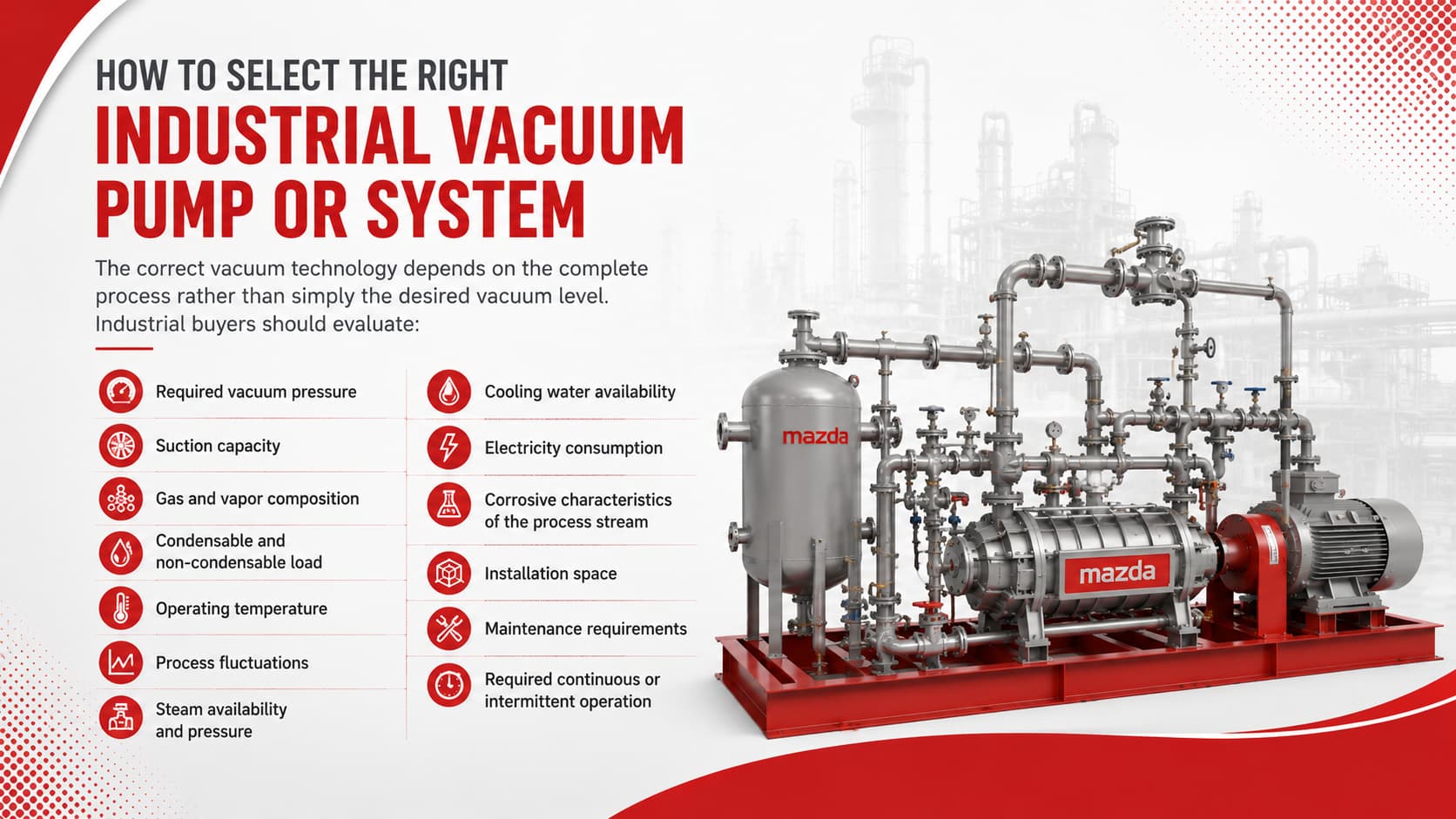
How to Select the Right Industrial Vacuum Pump or System
The correct vacuum technology depends on the complete process rather than simply the desired vacuum level. Industrial buyers should evaluate:
- Required vacuum pressure
- Suction capacity
- Gas and vapor composition
- Condensable and non-condensable load
- Operating temperature
- Process fluctuations
- Steam availability and pressure
- Cooling water availability
- Electricity consumption
- Corrosive characteristics of the process stream
- Installation space
- Maintenance requirements
- Required continuous or intermittent operation
A general technology-selection approach can be:
| Process Requirement | Suitable Mazda Technology |
| Continuous mechanical vacuum generation | Single/Double Stage Liquid Ring Vacuum Pump |
| Air and non-condensable gas removal using steam | Steam Jet Air Ejector (SJAE) |
| Combined vacuum generation for variable loads | Steam Jet Ejector + Liquid Ring Vacuum Pump |
| Hybrid steam and liquid jet vacuum generation | Steam Jet Ejector + Liquid Jet Ejector |
| High suction capacity with reduced steam consumption | Rotajector Ejector |
This table is a starting point rather than a substitute for engineering design. Final equipment selection should consider actual process data and site-specific operating conditions.
Read Our Article
Applications of Industrial Vacuum Pumps & Systems
Industrial vacuum equipment is used across numerous process applications where controlled pressure conditions are required.
Vacuum Distillation
Vacuum lowers the boiling temperature of process liquids, allowing separation of components at lower temperatures and supporting the processing of temperature-sensitive materials.
Evaporation
Vacuum evaporation can reduce boiling temperatures and support concentration of process liquids while improving thermal-process efficiency.
Drying
Vacuum systems help remove moisture or solvents at reduced pressure, which can be useful when products or materials are sensitive to elevated temperatures.
Steam Condensation
Vacuum equipment such as steam jet ejectors can remove air and non-condensable gases from condenser systems, helping maintain the required operating pressure.
Solvent Recovery
Vacuum can support controlled evaporation and separation of solvents from process streams, allowing valuable solvents to be recovered for reuse.
Degassing
Vacuum systems can remove air and other non-condensable gases from process equipment and liquid or vapor streams where controlled degassing is required.
Chemical, Pharmaceutical & Process Industries
Vacuum technology is used across chemical and pharmaceutical processes and other industrial applications where pressure control, evaporation, drying, separation, or gas removal is required.
Why Choose a Vacuum Pump Manufacturer in India?
For industrial buyers, purchasing directly from a vacuum pump manufacturer in India can provide advantages beyond equipment supply. A manufacturer with in-house engineering capability can evaluate process conditions and recommend the appropriate vacuum-generation technology.
Important benefits include:
- Application-specific equipment selection
- Customized vacuum system design
- In-house engineering and manufacturing
- Integration with condensers and auxiliary equipment
- Material selection for demanding process conditions
- Support for new installations and existing plants
- Technical and after-sales assistance
- Domestic and international project support
Mazda’s ability to offer multiple vacuum technologies also allows buyers to evaluate mechanical, steam-operated, and hybrid options based on their specific process and utility conditions.
We are Fast in Response
About Mazda Limited
Mazda Limited, established in 1977 and headquartered in Ahmedabad, India, is an engineering and manufacturing company serving industrial process applications. Its product capabilities include vacuum systems, heat transfer equipment, evaporation systems, air pollution control equipment, and related process technologies.
The company operates with ISO 9001, ISO 14001, and ISO 45001 certifications and holds relevant PED, IBR, ASME, and U-Stamp credentials across its engineering and manufacturing operations.
Mazda’s vacuum range includes liquid ring vacuum pumps, steam jet ejectors, combination vacuum systems, Rotajector ejectors, and supporting vacuum equipment. These technologies are engineered according to application requirements for both domestic and international customers.
Our Other Product
Frequently Asked Questions
What are the main types of industrial vacuum pumps?
Industrial vacuum technologies include mechanical pumps such as liquid ring vacuum pumps, steam jet vacuum systems such as steam jet air ejectors, and hybrid systems that combine different vacuum-generation technologies.
What is the difference between a liquid ring vacuum pump and a steam jet ejector?
A liquid ring vacuum pump generates vacuum mechanically using a rotating impeller and liquid ring, while a steam jet ejector uses high-pressure motive steam to generate suction. The better option depends on vacuum requirements, process load, utilities, maintenance considerations, and operating conditions.
Which vacuum pump is suitable for deep vacuum applications?
Deep vacuum requirements can be addressed through multi-stage steam jet ejector systems, liquid ring pump arrangements, or combination systems depending on the required vacuum level and process load. Equipment selection should be based on detailed process conditions.
What is a steam jet vacuum pump?
A steam jet vacuum pump, commonly called a steam jet ejector, uses high-pressure steam through a nozzle to entrain air or gases and generate vacuum. It has no conventional rotating components and can be configured for different vacuum requirements.
How do I choose an industrial vacuum pump?
Selection should consider required vacuum, suction capacity, process gas composition, condensable vapor load, temperature, steam and cooling-water availability, energy consumption, operating conditions, and maintenance requirements.
Conclusion
There is no single vacuum pump technology that is ideal for every industrial process. Liquid ring vacuum pumps, steam jet ejectors, and hybrid vacuum systems each provide different advantages depending on vacuum depth, suction capacity, process load, available utilities, and operating conditions.
As a vacuum pump manufacturer in India, Mazda Limited offers a broad range of vacuum-generation technologies, including single and double stage liquid ring vacuum pumps, Steam Jet Air Ejector systems, steam jet ejector and liquid ring vacuum pump combinations, steam jet and liquid jet ejector systems, and Rotajector ejectors. Supporting equipment such as thermo compressors, multi-nozzle boosters, and barometric condensers can also form part of integrated industrial vacuum systems.
Looking for a vacuum pump manufacturer or industrial vacuum system supplier in India? Contact Mazda Limited to discuss your process requirements and identify the appropriate vacuum technology for your application.