


Read Our Article
Vacuum Pump Manufacturer in India: Types of Industrial Vacuum Pumps & Systems

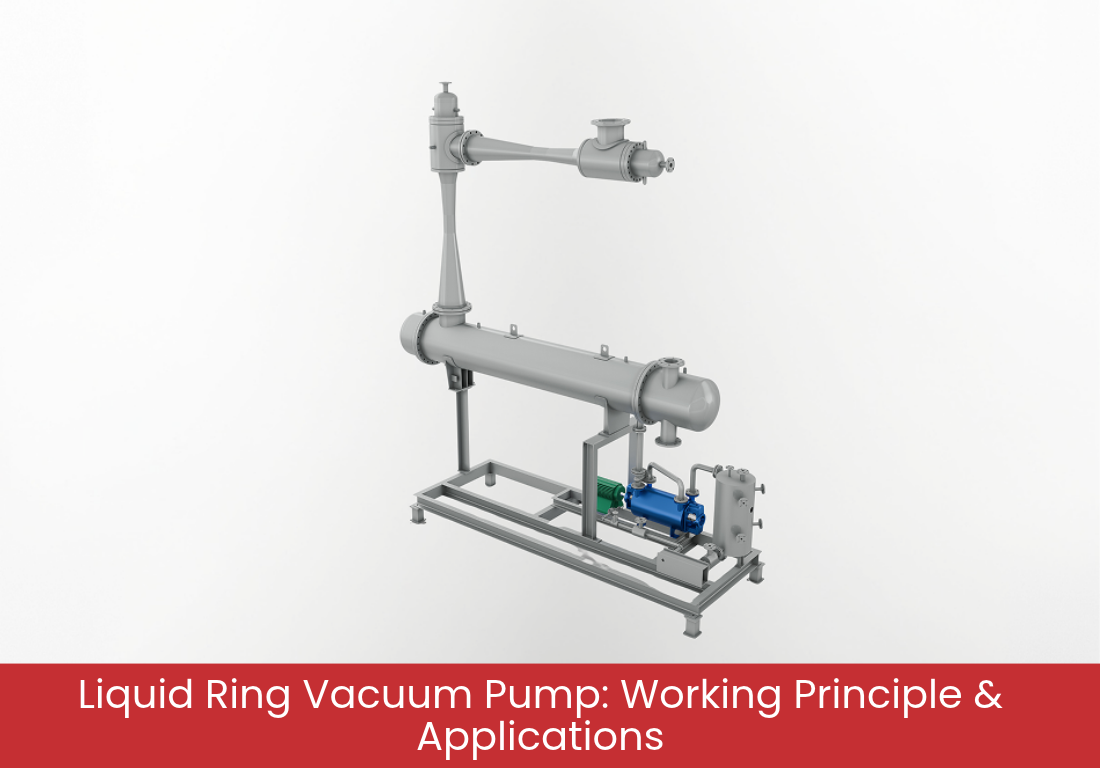
Vacuum technology plays an important role in industrial processes that require the controlled removal of air, gases, and vapours. From chemical processing and pharmaceutical manufacturing to power generation and food production, vacuum systems help maintain the operating conditions required for efficient and reliable operations. Among the different types of industrial vacuum equipment, a liquid ring vacuum pump is widely used for applications involving wet gases, vapours, and certain process streams containing condensable components.
Understanding the liquid ring vacuum pump working principle helps engineers, plant operators, and procurement professionals determine whether this technology is suitable for their process requirements. Unlike many conventional vacuum pumps, a liquid ring vacuum pump uses a rotating ring of liquid to create chambers that draw in, compress, and discharge gases.
Its operating mechanism is relatively simple, making it useful in industrial environments where dependable vacuum generation and the handling of moisture-laden gas streams are important. The pump’s performance depends on factors such as the sealing liquid, operating temperature, suction pressure, gas composition, and required capacity.
A liquid ring vacuum pump is a rotary positive-displacement pump designed to remove gases from a system and create vacuum. It typically uses water or another compatible liquid as the sealing medium. During operation, an impeller rotates inside an eccentrically positioned casing, causing the liquid to form a ring around the inside of the casing.
Because the impeller is positioned off-centre, the space between the impeller blades and the liquid ring changes as the rotor turns. These changing spaces form chambers that expand and contract, enabling the pump to draw in gas, compress it, and discharge it.
Liquid ring vacuum pumps are particularly useful in processes where the gas stream contains moisture or condensable vapours. Their suitability for a specific application depends on the process conditions, liquid compatibility, required vacuum level, and gas-handling requirements.
The working principle of a liquid ring vacuum pump is based on the formation of a rotating liquid ring and the variation in volume between the impeller blades. The pump uses centrifugal force to move the sealing liquid towards the casing wall, forming a ring around the impeller.
The impeller is mounted eccentrically within the casing. As it rotates, the distance between the impeller hub and the liquid ring changes relative to the position of the rotor. This movement causes the spaces between adjacent impeller blades to expand and contract.
When these spaces expand, the pressure inside the chambers decreases, allowing gas to enter through the suction port. As the impeller continues rotating, the chambers become smaller and compress the trapped gas. The compressed gas then exits through the discharge port.
This cycle repeats continuously, allowing the pump to maintain vacuum in the connected process equipment.
The sealing liquid enters the pump casing. As the impeller rotates, centrifugal force pushes the liquid outward, forming a rotating ring along the inner casing wall.
The eccentric position of the impeller creates expanding chambers between the impeller blades and the liquid ring. As these chambers increase in volume, their pressure decreases, drawing gas into the pump through the suction port.
As rotation continues, the chambers decrease in volume. The trapped gas is compressed as the liquid ring moves relative to the impeller blades.
When the chambers reach the discharge port, the compressed gas leaves the pump. The continuous rotation of the impeller sustains the suction, compression, and discharge cycle.
The combined action of these stages produces vacuum without requiring the gas to be compressed by a conventional piston arrangement.
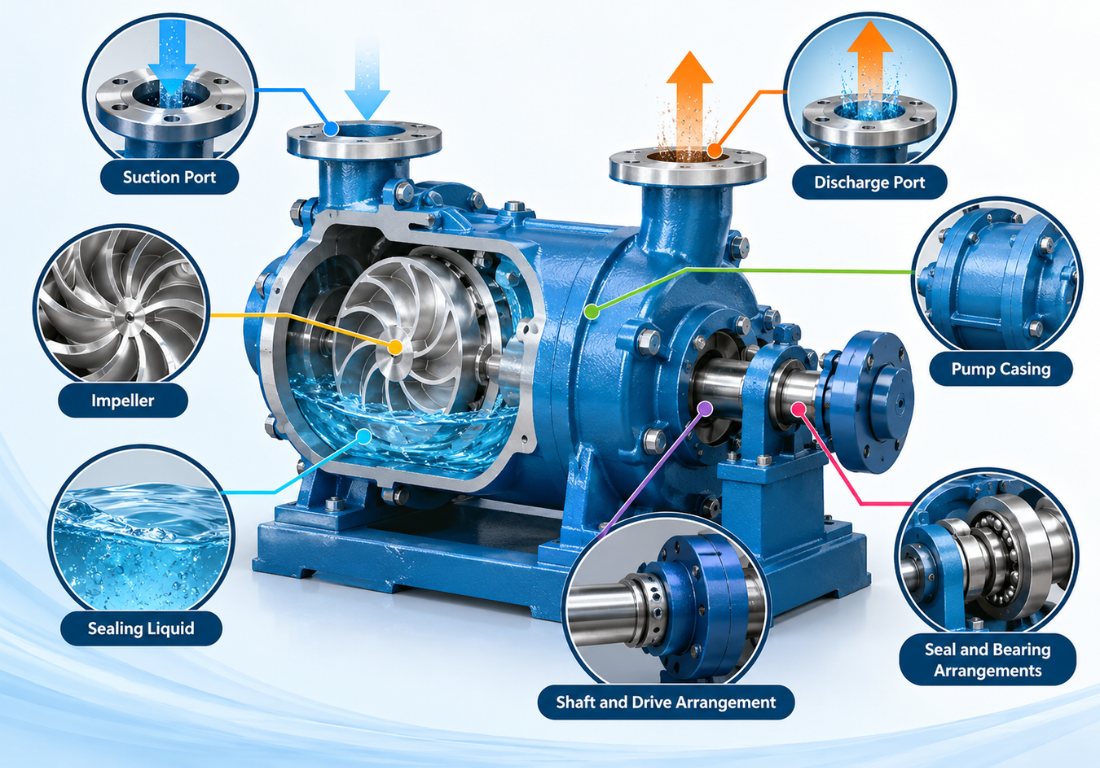
Understanding the major components helps explain how a liquid ring vacuum pump operates and what influences its performance.
The impeller is the rotating component that drives the sealing liquid and creates the changing chambers used for gas suction and compression. Its geometry and operating speed influence the pump’s performance.
The casing houses the impeller and sealing liquid. Its internal geometry supports the formation of the liquid ring and directs gas through the suction and discharge passages.
The sealing liquid forms the ring that creates the variable-volume chambers. Water is commonly used, although other compatible liquids may be selected according to process requirements, temperature, and chemical compatibility.
The suction port connects the pump to the equipment or process from which air and gases must be removed. Gas enters the pump as the internal chambers expand.
The discharge port allows compressed gas to leave the pump. Depending on the system arrangement, the discharged gas and sealing liquid may flow into a separator.
The shaft transfers rotational power from the motor or other drive arrangement to the impeller. Correct alignment and suitable operating conditions help support reliable operation.
Seals help prevent unwanted leakage around the rotating shaft, while bearings support the shaft during operation. Their design depends on the pump configuration and operating requirements.
Our Other Product
The sealing liquid is essential to the operation of a liquid ring vacuum pump. It forms the ring that creates the chambers required for gas suction and compression. It also absorbs heat generated during compression and through contact with the gas being handled.
The choice of sealing liquid depends on several factors:
The sealing liquid should therefore be selected according to the process conditions rather than treating water as the correct option for every application.
Liquid ring vacuum pumps are available in different configurations, including single-stage and double-stage designs. The appropriate option depends on the required suction pressure, gas-handling capacity, process conditions, and overall system design.
| Feature | Single-Stage Pump | Double-Stage Pump |
|---|---|---|
| Compression arrangement | One compression stage | Two compression stages |
| Vacuum requirements | Suitable for applications within its operating range | Can support applications requiring a deeper vacuum within the selected design’s limits |
| System configuration | Simpler arrangement | Additional stage and associated flow passages |
| Selection considerations | Required capacity, suction pressure, and process conditions | Required vacuum level, capacity, and operating efficiency |
A double-stage pump is not automatically the best choice for every application. The final selection should be based on the required operating point and the manufacturer’s performance data.
Mazda Limited offers single-stage and double-stage liquid ring vacuum pump solutions for industrial applications. Its product page also describes combination options involving air ejectors to support lower suction pressures and help address cavitation-related operating concerns where the system design permits.
Liquid ring vacuum pumps offer several advantages for suitable industrial applications.
The liquid-sealed operating mechanism makes these pumps useful for handling gas streams containing moisture and condensable vapours, subject to process compatibility and operating limits.
The rotating impeller continuously creates expanding and contracting chambers, enabling ongoing gas suction, compression, and discharge during operation.
The pump generates vacuum through the interaction between the impeller and the liquid ring. This avoids the need for a reciprocating piston arrangement.
The sealing liquid absorbs some of the heat generated during gas compression. This can be advantageous in applications where thermal management is important.
Different pump configurations and sealing-liquid arrangements allow the technology to be considered for a range of process conditions.
Liquid ring vacuum pumps can be integrated with equipment such as air ejectors, separators, and liquid circulation systems when the application requires a combined vacuum arrangement.
Actual performance, maintenance requirements, and operating costs depend on the selected design, sealing liquid, process conditions, and installation.
Liquid ring vacuum pumps are used in industries that require dependable vacuum generation and the handling of wet gases or vapours.
Chemical plants use vacuum systems in operations such as distillation, solvent recovery, drying, and gas removal. A liquid ring vacuum pump may be suitable where the process involves vapours or moisture, provided the sealing liquid and construction materials are compatible with the process stream.
Vacuum is used in selected pharmaceutical operations, including drying, filtration, and solvent-handling processes. Pump selection must account for process cleanliness, chemical compatibility, required vacuum levels, and applicable plant requirements.
Vacuum equipment supports selected power-generation processes and auxiliary systems. Liquid ring vacuum pumps may be considered where their operating range and gas-handling characteristics match the application’s requirements.
Vacuum technology is used in processes such as vacuum drying, deaeration, and selected packaging operations. The pump and sealing-liquid arrangement must be appropriate for the process and any applicable hygiene requirements.
Vacuum systems are used in several pulp and paper operations, including selected dewatering and process applications. The required capacity, moisture conditions, and continuous operating demands influence pump selection.
Vacuum equipment may support selected treatment, filtration, and utility operations. Suitability depends on the gas stream, liquid compatibility, required vacuum, and operating conditions.
Selecting the right pump requires more than comparing motor power or nominal capacity. The following factors should be evaluated before finalizing a design.
Consulting the manufacturer’s performance data and providing accurate process conditions are important steps in selecting a suitable vacuum pump.
Our Other Product
Combination of Vacuum Systems of Steam Jet Ejector & Liquid Jet Ejector
Mazda Limited provides industrial vacuum and thermal engineering solutions for process applications. Its single-stage and double-stage liquid ring vacuum pump offering is designed for applications requiring industrial vacuum generation.
According to Mazda’s product information, the available configurations focus on vacuum performance, operating reliability, and power-use considerations. The company also describes combination options involving air ejectors for applications that require lower suction pressures and support against cavitation-related concerns.
When evaluating a vacuum system, plant engineers should consider the required suction pressure, gas composition, capacity, sealing-liquid conditions, and operating environment. These details help determine the appropriate pump configuration and whether an integrated vacuum arrangement is necessary.
A liquid ring vacuum pump works by rotating an impeller inside a casing containing sealing liquid. The liquid forms a ring around the casing wall, creating chambers that expand to draw in gas, contract to compress it, and discharge it through the outlet.
The liquid forms the ring that creates variable-volume gas chambers. It also helps seal the chambers and absorbs heat during compression. Water is commonly used, but other liquids may be required depending on process compatibility and operating conditions.
Yes. Liquid ring vacuum pumps are often considered for wet gases and condensable vapours. However, suitability depends on gas composition, temperature, sealing-liquid compatibility, and the pump's specified operating limits.
A single-stage pump compresses gas through one stage, while a double-stage design uses two stages. A double-stage configuration may be suitable for applications requiring a deeper vacuum, but the correct choice depends on the required operating point and performance data.
Performance is influenced by suction pressure, gas flow rate, sealing-liquid temperature and vapour pressure, gas composition, operating speed, and the pump's design. Higher sealing-liquid temperatures can limit the achievable vacuum.
These pumps are used in suitable applications across chemical processing, pharmaceuticals, power generation, food and beverage manufacturing, pulp and paper, and water treatment. The specific application must be assessed against the pump's operating limits.
Yes. Some vacuum systems combine a liquid ring vacuum pump with an air ejector to support applications requiring lower suction pressures. The benefits depend on the system configuration and process conditions.
Selection should consider required suction pressure, gas capacity, gas composition, operating temperature, sealing-liquid properties, materials of construction, stage configuration, and auxiliary equipment. Manufacturer performance data should be used to confirm suitability.
The liquid ring vacuum pump working principle relies on a rotating liquid ring and changing chamber volumes to draw in, compress, and discharge gases. This mechanism makes liquid ring vacuum pumps useful for selected industrial applications involving wet gases, condensable vapours, and continuous vacuum requirements.
Choosing between single-stage and double-stage designs requires an assessment of suction pressure, gas capacity, sealing-liquid conditions, and process compatibility. By evaluating these parameters carefully, industrial facilities can select a vacuum solution suited to their operating requirements.
Mazda Limited’s single-stage and double-stage liquid ring vacuum pump solutions provide an option for industries evaluating industrial vacuum equipment. Reviewing the process conditions and the manufacturer’s specifications is the best starting point for identifying the appropriate configuration.





Our team is available to provide professional support and will respond promptly to any inquiries or assistance you need.