


Read Our Article
Liquid Ring Vacuum Pump Working Principle: Components, Operation and Industrial Applications

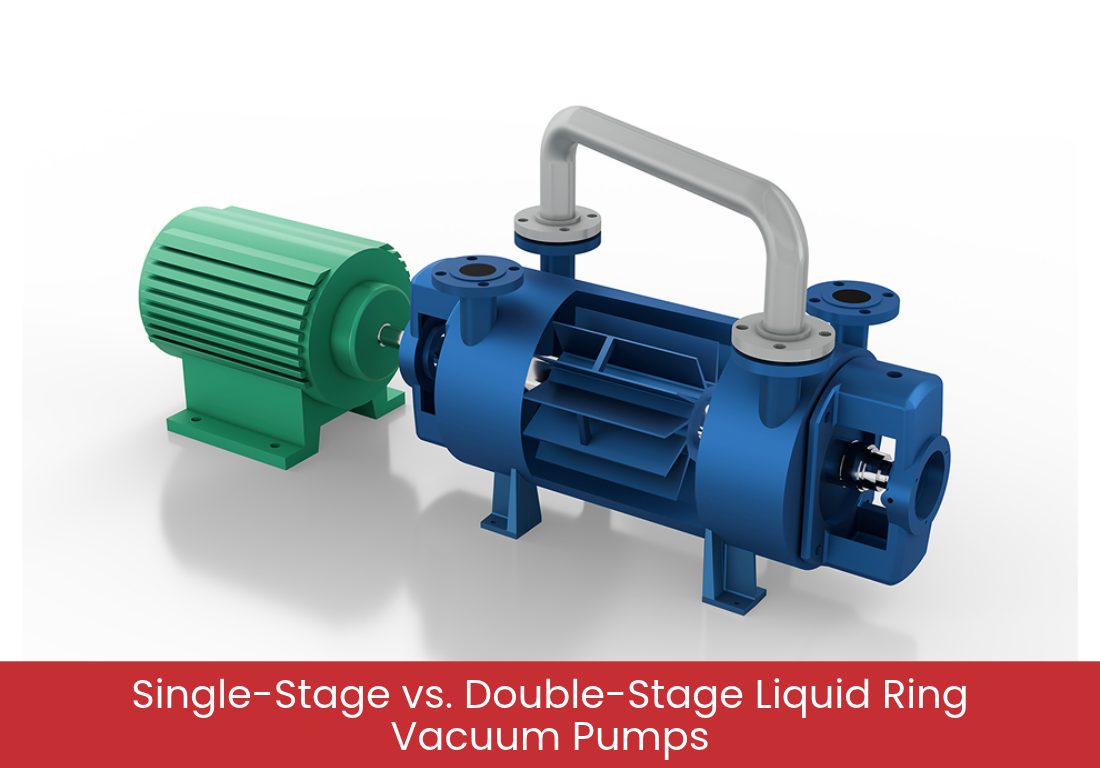
Choosing the right vacuum pump is an important decision for any industrial facility where process pressure, production capacity and operating costs drive performance. Liquid ring vacuum pumps are commonly chosen for applications involving wet gases, condensable vapours and demanding process conditions.
Selecting one, however, involves more than sizing for capacity. Engineers must also decide whether a single-stage or two-stage configuration better suits the duty.
The difference lies in how gas compression is arranged. A single-stage design completes compression in one stage. A two-stage design compresses the gas through two successive stages. This affects the achievable vacuum level, performance at lower suction pressures and suitability for particular process conditions.
This guide compares both configurations, explains their benefits, and covers the factors that should guide pump selection for plant engineers, project managers and procurement teams.
A single-stage liquid ring vacuum pump is a rotary positive-displacement pump that uses one compression stage to remove gases from a process and discharge them at outlet pressure.
During operation, an impeller rotates inside a casing that contains sealing liquid. The liquid forms a rotating ring, and the impeller’s eccentric position creates chambers that change in volume as the rotor turns. These chambers draw gas in, compress it and discharge it.
Because compression happens in a single stage, the design is simpler than a two-stage arrangement.
A single-stage pump is not a lesser option. For applications within its vacuum range, it is often the more appropriate choice. Its suitability should be confirmed using the manufacturer’s performance curves and actual process conditions.
A two-stage liquid ring vacuum pump uses two successive compression stages. Gas passes through the first stage and then moves to the second stage for further compression before final discharge.
Distributing compression across two stages allows a two-stage pump to reach a deeper vacuum than a comparable single-stage design. This makes it relevant where a process requires lower absolute suction pressure or must maintain performance as operating pressure falls.
The advantages of a two-stage pump depend on whether the process actually needs the additional compression stage, so the duty should drive the decision.
| Comparison Factor | Single-Stage Pump | Two-Stage Pump |
|---|---|---|
| Compression arrangement | One stage | Two successive stages |
| Vacuum capability | Suited to its specified vacuum range | Can achieve deeper vacuum |
| System configuration | Simpler | Includes an additional compression stage |
| Lower-pressure operation | Must be checked against the required suction pressure | Offers advantages at lower suction pressures |
| Energy considerations | Appropriate for moderate-vacuum duties | Can perform better in deeper-vacuum duties |
| Selection priority | Capacity, required pressure and process conditions | Deeper-vacuum requirement, capacity and operating conditions |
The key distinction is not the number of stages. It is how each configuration performs at the specific suction pressure, gas load and operating conditions of the process.
Vacuum level is usually the main reason engineers compare these two configurations.
A single-stage pump compresses gas in one stage. As suction pressure falls, its pumping capacity and efficiency can change significantly, depending on design and operating conditions.
A two-stage pump spreads compression across two stages. This allows it to reach a lower absolute pressure and perform better in applications that need a deeper vacuum.
The vacuum actually achievable by either pump depends on:
Selection should therefore be based on the manufacturer’s performance data rather than stage count alone. A two-stage configuration is worth considering when the required operating point falls outside the practical range of a single-stage pump.
Our Other Product
The most efficient configuration is the one that meets the process requirement without unnecessary energy use or equipment complexity.
Single-stage pumps are efficient when the required vacuum sits within their operating range. Their simpler configuration also eases selection and integration. If the application needs a deeper vacuum than the pump can efficiently maintain, a different configuration is likely to be a better fit.
Two-stage pumps divide compression between two stages, which improves performance at lower operating pressures. Where a deeper vacuum is required, a two-stage pump can meet the duty more effectively than an undersized single-stage alternative. Our two-stage pumps are designed to reduce power consumption and extend motor life, which supports long-term operating cost savings.
Look beyond the purchase price and consider:
A correctly selected pump avoids unnecessary energy consumption, unstable operation and oversized equipment.
The choice should start with the application, not a preference for one design.
Determine the absolute pressure needed during normal operation, startup and peak demand. If a deeper vacuum is needed, evaluate a two-stage configuration.
The pump must handle the required gas volume at the specified suction pressure. Assess capacity at the actual operating point, not just nominal or maximum figures.
Both configurations handle wet gas and vapour. The composition and quantity of condensable vapours affect capacity, sealing-liquid conditions and overall performance.
Higher sealing-liquid temperatures increase vapour pressure and can limit the achievable vacuum, so temperature control may be necessary.
Many processes see changing gas loads, pressures or temperatures. Evaluate the pump across the full expected operating range, not just one design point.
Pump materials and sealing liquid must be compatible with the gases, vapours and contaminants in the process. Corrosive or reactive streams may need specific construction materials.
In some applications, a standalone liquid ring pump is not the best solution. An air ejector combination, a steam ejector arrangement or a hybrid vacuum system may be more appropriate depending on the required pressure, gas load and operating conditions.
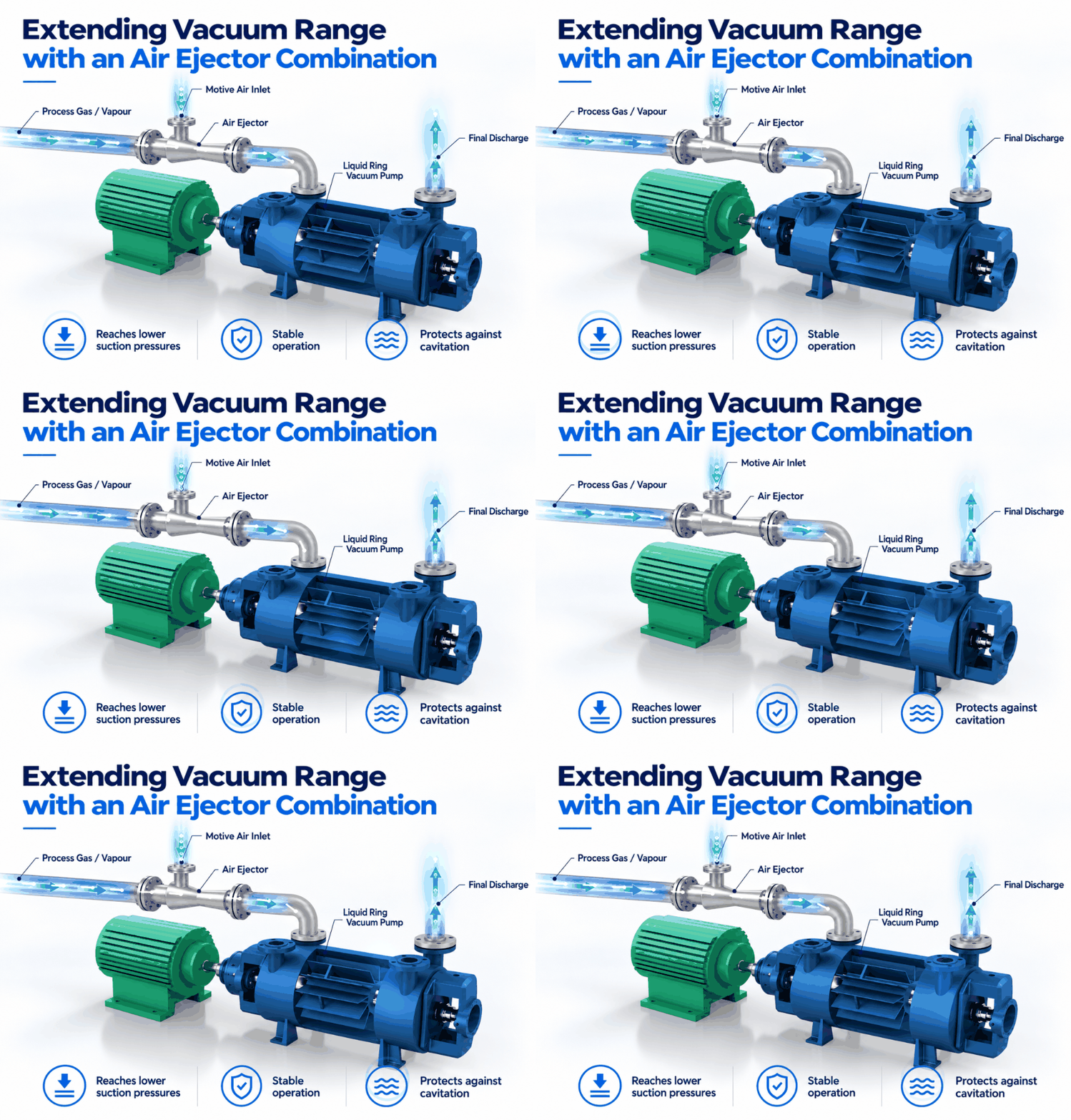
Some liquid ring vacuum pump installations include an air ejector ahead of the pump to reach lower suction pressures than the pump can achieve alone.
In this arrangement, ambient air enters through a motive air inlet and is accelerated through a venturi nozzle. The high-velocity jet entrains gases or vapours from the process. The ejector compresses the mixture and discharges it into the liquid ring vacuum pump, which compresses it further before final discharge.
This combination helps maintain stable operation at lower suction pressures and protects the pump against cavitation. It is worth evaluating when the required vacuum is close to, or beyond, what the liquid ring pump can maintain on its own. Our liquid ring vacuum pumps are available with a combination air ejector option for exactly these duties.
Both configurations are used across many industries. The right choice depends on the specific vacuum duty, not the industry alone.
Chemical and Petrochemical Processing: Vacuum supports distillation, drying, solvent handling and gas removal. Pump selection depends on suction pressure, gas composition and vapour load.
Pharmaceutical Manufacturing: Vacuum is used in drying, filtration and solvent handling. Selection must account for vacuum level, process cleanliness and chemical compatibility.
Power Generation: Vacuum equipment supports condenser-related and auxiliary duties. The system must be matched to the required pressure, capacity and gas load.
Pulp and Paper Manufacturing: Vacuum is used in dewatering, filtration and drying. Moisture conditions, capacity and continuous-production demands guide the choice.
Food and Beverage Processing: Applications include vacuum drying, deaeration and packaging, where equipment must meet hygiene and material requirements.
Water and Wastewater Treatment: Vacuum supports filtration, treatment and utility processes. The right configuration depends on the gas stream, operating pressure and liquid conditions.
Replacement is worth evaluating when a process needs a deeper vacuum, operating conditions have changed, or the existing pump cannot maintain the required performance.
Before making a change, assess:
A technical evaluation shows whether the existing pump is incorrectly sized, operating outside its intended range, or genuinely needs a different configuration.
For some applications, combining vacuum technologies provides a better fit than a single pump.
For example, a steam jet ejector and liquid ring vacuum pump combination uses the ejector for high-capacity suction and the liquid ring pump for further vacuum generation. An inter condenser can be added to condense steam and reduce the load reaching the pump.
This approach suits demanding vacuum requirements, mixed condensable and non-condensable gases, and varying process loads. The decision between a single-stage pump, a two-stage pump and a combined system should consider the complete process, not the pump in isolation.
We manufacture single-stage and double-stage liquid ring vacuum pumps for industrial vacuum duties. Our two-stage pumps are designed to deliver higher vacuum and capacity with reduced power consumption, supporting long-term savings in operating costs. They are built for stable, reliable operation and low maintenance in demanding industrial environments. With the combination air ejector option, they can achieve lower suction pressures and stay protected against cavitation.
Our Other Product
To help us recommend the right configuration, share your required suction pressure, gas flow rate, vapour composition, operating temperature and expected load variations.
A single-stage pump compresses gas in one stage, while a two-stage pump compresses it through two successive stages. A two-stage design can achieve deeper vacuum levels, while a single-stage pump is sufficient for applications within its operating range.
No. A two-stage pump is better suited to applications needing a deeper vacuum, but not to every process. Required pressure, gas capacity, energy consumption, sealing-liquid conditions and total operating costs should guide the decision.
A two-stage (double-stage) liquid ring vacuum pump is typically chosen when an application requires a deeper vacuum than a comparable single-stage design can provide. An air ejector combination can extend the achievable vacuum further.
It depends on the duty. A single-stage pump is efficient for moderate-vacuum duties, while a two-stage design performs better in deeper-vacuum duties. Efficiency should be compared using manufacturer performance data at the required operating point.
Yes. Both handle wet gases and condensable vapours. Suitability depends on gas composition, vapour load, sealing-liquid compatibility, temperature and the pump’s operating limits.
Key factors include required suction pressure, gas flow rate, gas composition, vapour load, sealing-liquid temperature, material compatibility, expected operating variations and energy requirements.
Yes, when the application requires a deeper vacuum or the existing pump cannot meet operating conditions. The decision should follow a technical assessment of capacity, pressure, gas load, installation requirements and energy consumption.
Yes. A steam jet ejector and liquid ring vacuum pump combination suits demanding applications involving condensable vapours, non-condensable gases or changing process loads.
An air ejector uses ambient air accelerated through a venturi nozzle to draw in process gases and pre-compress them before they enter the liquid ring pump. This allows the system to reach lower suction pressures and helps protect the pump against cavitation.
The choice between single-stage and two-stage liquid ring vacuum pumps comes down to vacuum level, gas capacity and process conditions. A single-stage pump is the right fit when the duty falls within its range. A two-stage pump, or a pump with an air ejector combination, is the better choice when a deeper vacuum is needed.
We manufacture both configurations, along with ejector, hybrid and heat transfer systems, so we can recommend a standalone pump or a complete vacuum solution based on your process requirements.





Our team is available to provide professional support and will respond promptly to any inquiries or assistance you need.