


Quick Read
- Feedwater heaters use steam or another suitable heat source to raise the temperature of boiler feedwater before it enters the boiler or steam generator.
- High-pressure (HP) and low-pressure (LP) feedwater heaters operate at different points in the steam-water cycle to support regenerative heating.
- Feedwater preheating helps reduce the additional heat required in the boiler and can improve overall thermal cycle efficiency.
- Heater performance depends on heat transfer design, operating pressure, steam conditions, feedwater flow, and condensate management.
- We provide HP and LP feedwater heater solutions, along with condensers, dump condensing systems, dump tubes, and other heat transfer equipment for industrial applications.
Introduction to Feedwater Heaters
Efficient heat management is essential in thermal power plants and industrial facilities that rely on steam for power generation or process heating. Every stage of the steam-water cycle influences how effectively energy is used, from steam generation and turbine operation to condensation and the return of water to the boiler.
Feedwater heaters play an important role in this cycle by raising the temperature of water before it enters the boiler or steam generator. Rather than relying entirely on additional fuel to heat relatively cold water, a regenerative steam cycle can use steam extracted from selected turbine stages to transfer heat to the feedwater.
This arrangement helps recover useful thermal energy within the plant. When properly designed and integrated, feedwater heating can improve cycle efficiency, reduce the heat input required from the boiler, and support more gradual heating of downstream equipment.
Understanding the different types of feedwater heaters, their working principles, and their design considerations helps plant operators, engineers, and procurement teams select equipment suited to their operating requirements.
What Is a Feedwater Heater?
A feedwater heater is a heat exchanger that raises the temperature of water supplied to a boiler or steam generator. In conventional steam power plants, the heat source is commonly steam extracted from the turbine at an appropriate pressure.
The heater transfers thermal energy to the feedwater before it reaches the next stage of the steam-water cycle. This process is known as regenerative feedwater heating because it reuses energy available within the cycle instead of relying entirely on additional heat from fuel.
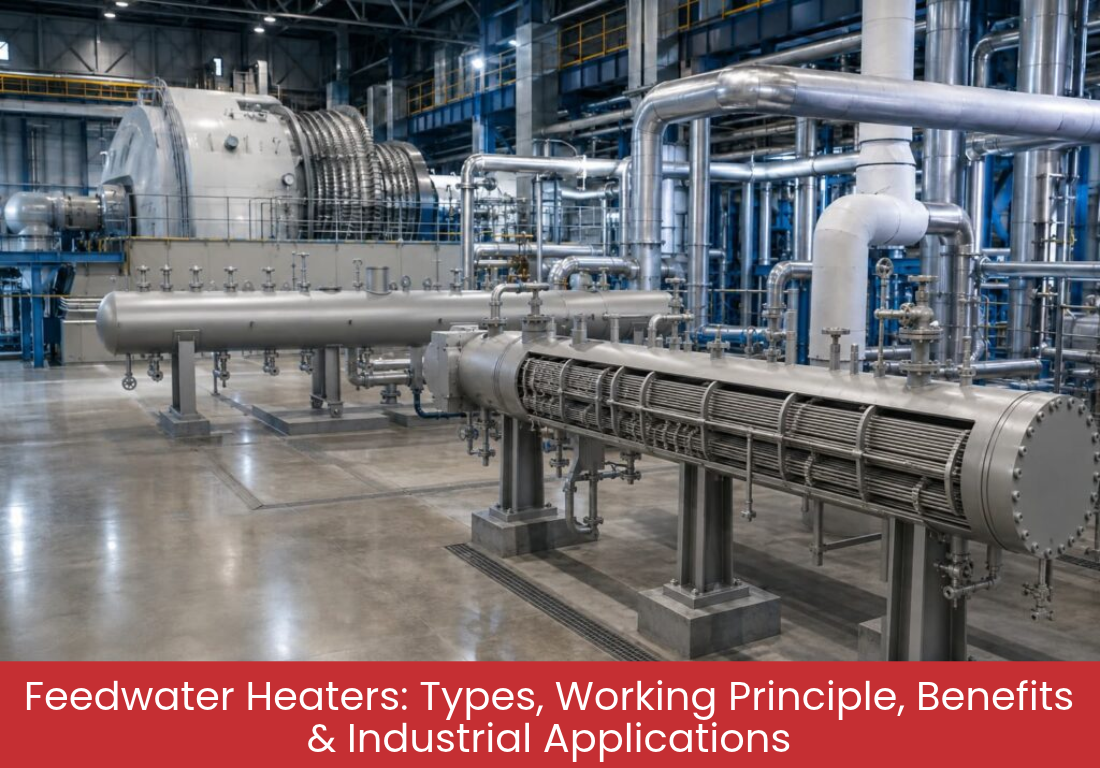
Many industrial feedwater heaters use a shell-and-tube configuration. In a typical closed feedwater heater, feedwater flows through tubes while extracted steam enters the shell side. Heat passes through the tube walls, warming the feedwater without directly mixing it with the heating steam.
Feedwater heaters are generally classified as high-pressure or low-pressure units according to their operating position and pressure conditions within the steam-water cycle.
How Does a Feedwater Heater Work?
The feedwater heater working principle is based on heat transfer between a hot source and the cooler water being heated. In a typical closed heater, steam extracted from a turbine transfers heat to feedwater flowing through a tube bundle.
The process can be understood through the following stages.
Feedwater Enters the Heater
Water from the condensate or feedwater system enters the heater through the designated inlet. Its pressure, temperature, and flow rate depend on the heater’s location within the plant.
Heating Steam Enters the Shell Side
Steam extracted from a suitable turbine stage enters the shell side of the heat exchanger. The pressure and temperature of this steam determine the available heating conditions.
Heat Transfers Through the Tube Walls
Thermal energy moves from the hotter steam to the cooler feedwater through the tube walls. The feedwater temperature rises as it passes through the heat transfer surface.
Steam Condenses and Releases Heat
As steam transfers its latent heat, it condenses into liquid. The resulting condensate is managed through the heater’s drainage arrangement and may be returned to an appropriate point in the steam-water cycle.
Heated Feedwater Moves to the Next Stage
The preheated water leaves the heater and continues towards the next component, such as another feedwater heater, the deaerator, the boiler economizer, or the boiler, depending on the plant configuration.
Some heaters incorporate additional heat transfer zones to improve thermal performance. These can include desuperheating sections for cooling superheated extraction steam and drain-cooling sections for recovering additional heat from the condensed steam.
Types of Feedwater Heaters
Feedwater heaters are commonly divided into high-pressure and low-pressure types. Both support regenerative heating, but their positions in the cycle and their operating conditions differ.
High-Pressure Feedwater Heaters
A high-pressure feedwater heater (HP heater) is typically installed downstream of the boiler feed pump and upstream of the economizer or boiler. It heats feedwater that has already been pressurized by the feed pump.
Because these heaters operate on the high-pressure side of the cycle, their pressure-containing components must be designed for the specified operating and design conditions.
How HP Feedwater Heaters Work
Steam extracted from a suitable turbine stage enters the heater and transfers heat to the pressurized feedwater. In a closed heater, the two fluids remain separated by the tube walls.
As the feedwater temperature increases, the boiler requires less additional heat to bring the water to the required steam-generation conditions. This supports regenerative cycle efficiency.
Key Considerations for HP Heaters
- Design pressure and temperature on both fluid sides.
- Feedwater flow rate and required outlet temperature.
- Extraction steam conditions.
- Tube-side and shell-side pressure drops.
- Condensate drainage and drain-cooling requirements.
- Materials, mechanical integrity, inspection, and maintenance access.
The final design must match the specific plant duty rather than rely on a generic HP heater specification.
Low-Pressure Feedwater Heaters
A low-pressure feedwater heater (LP heater) is generally positioned in the condensate section of the steam-water cycle, commonly between the main condenser and the deaerator. Its purpose is to raise the temperature of condensate before it proceeds to the next stage.
LP heaters typically use lower-pressure steam extracted from an appropriate turbine stage. They help recover thermal energy that would otherwise be lost from the cycle.
How LP Feedwater Heaters Work
Condensate from the condenser passes through the heater’s feedwater side. Extracted steam transfers heat to the cooler condensate, increasing its temperature before it moves towards the deaerator or another downstream component.
The arrangement depends on the plant’s design and the number and sequence of heaters in the feedwater train.
Key Considerations for LP Heaters
- Condensate flow rate and inlet temperature.
- Extraction steam pressure and temperature.
- Required feedwater outlet temperature.
- Condensation and drainage conditions.
- Available installation space.
- Integration with the condenser, deaerator, and other feedwater equipment.
Although LP heaters operate at lower pressures than HP heaters, their role in recovering energy and preparing feedwater remains important to the overall cycle.
High-Pressure vs. Low-Pressure Feedwater Heaters
The primary difference between HP and LP heaters is their location and operating pressure within the steam-water cycle.
| Comparison Factor | HP Feedwater Heater | LP Feedwater Heater |
|---|---|---|
| Typical Location | After the boiler feed pump, before the economizer or boiler | Between the main condenser and deaerator in many conventional arrangements |
| Feedwater Condition | Pressurized boiler feedwater | Condensate at a lower pressure |
| Heating Steam | Extracted steam at suitable higher pressure | Extracted steam at suitable lower pressure |
| Main Purpose | Further preheats pressurized feedwater before steam generation | Preheats condensate earlier in the cycle |
| Design Considerations | Higher pressure and temperature requirements | Lower pressure conditions relative to HP heaters |
| Cycle Contribution | Reduces the additional heat required for final feedwater heating | Recovers energy from extraction steam during early feedwater heating |
Both types work together in many power plants. Their number, arrangement, and individual duties depend on the steam-cycle design and performance requirements.
Important Components of a Feedwater Heater
Feedwater heater construction varies according to its type and duty. Common components of a closed shell-and-tube unit include the following.
Shell
The shell forms the pressure-containing body around the tube bundle. It provides the flow space for the heating steam and supports the required pressure and temperature conditions.
Tube Bundle
The tube bundle provides the heat transfer surface between the heating steam and feedwater. Tube material, dimensions, arrangement, and surface area are selected according to the design requirements.
Tube Sheets
Tube sheets hold the tubes in position and separate the tube-side fluid from the shell-side fluid. Their design must account for mechanical loads and operating conditions.
Inlet and Outlet Connections
These connections direct feedwater, extraction steam, and condensate into and out of the heater. Their size and arrangement depend on the required flow rates and system layout.
Condensate Drainage Arrangement
As the heating steam condenses, the resulting liquid must be removed in a controlled manner. The drainage system helps maintain the intended operating conditions and supports efficient heat transfer.
Internal Heat Transfer Zones
Depending on the application, a heater may include condensing, desuperheating, and drain-cooling zones. These sections support heat recovery under different steam and condensate conditions.
Why Are Feedwater Heaters Important in Power Plants?
Feedwater heaters support the efficient use of thermal energy in a steam power cycle. Their benefits depend on the plant configuration, extraction steam conditions, heater design, and operating practices.
Improved Thermal Cycle Efficiency
Preheating feedwater reduces the additional heat required to bring it to the conditions needed for steam generation. In regenerative cycles, this can improve overall thermal efficiency.
Better Use of Available Steam Energy
Extraction steam transfers useful heat to the feedwater instead of all of that energy being rejected at a later stage of the cycle. The benefit must be assessed alongside the effect of steam extraction on turbine power output.
Reduced Boiler Heat Input
Because feedwater enters the boiler at a higher temperature, less additional heat is needed to reach the required operating conditions. The actual reduction depends on the plant’s design and operating point.
More Gradual Feedwater Heating
Raising water temperature in stages can reduce the temperature difference between incoming feedwater and downstream equipment. This helps manage thermal stresses when the system is designed and operated correctly.
Support for Integrated Steam-Cycle Operation
Feedwater heaters operate alongside condensers, pumps, deaerators, turbines, and other equipment. Their performance therefore depends on effective integration with the wider steam-water cycle.
Common Applications of Feedwater Heaters
Thermal Power Plants
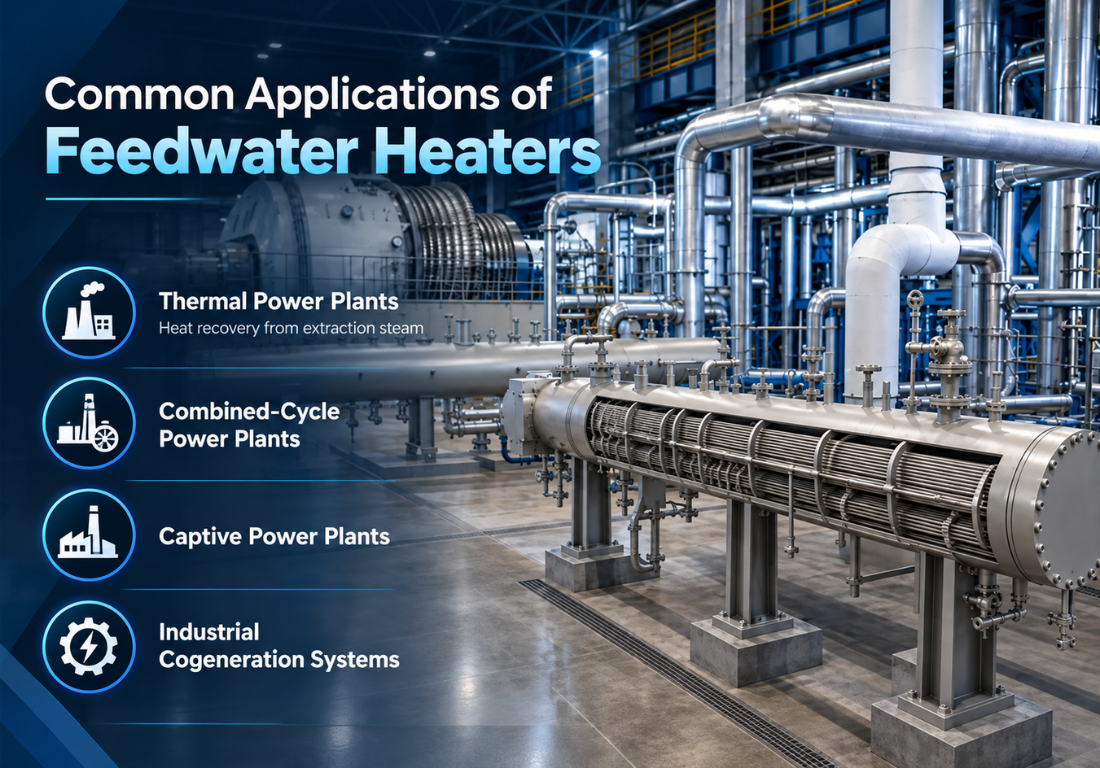
Thermal power plants use HP and LP feedwater heaters to recover heat from turbine extraction steam and preheat water before it returns to the boiler. Heater arrangement depends on the steam-cycle configuration and generating capacity.
Combined-Cycle Power Plants
Combined-cycle facilities use gas turbines alongside steam cycles to generate electricity. Feedwater heating may be incorporated into the steam-cycle design to support effective heat recovery and operation.
Captive Power Plants
Industrial facilities with captive power generation can use feedwater heaters to improve thermal management within their steam systems. Equipment selection depends on the plant’s steam demand, operating schedule, and process integration.
Industrial Cogeneration Systems
Cogeneration plants generate electricity and useful heat from a shared energy source. Feedwater heaters may be included where the steam-cycle design benefits from regenerative heating and effective condensate management.
The precise configuration must be determined from the facility’s heat balance, steam conditions, water flow, and operating requirements.
Factors to Consider When Selecting a Feedwater Heater
Choosing a suitable feedwater heater requires a detailed understanding of the process duty and the plant layout. Key considerations include:
- Operating and design pressure: Establish the pressure conditions on both the feedwater and heating-steam sides.
- Temperature requirements: Determine inlet and outlet temperatures and the required heat duty.
- Flow rate: Confirm feedwater flow and available extraction steam under normal and varying operating conditions.
- Heat transfer surface: Select an appropriate design based on the required thermal performance and available space.
- Material selection: Consider fluid chemistry, corrosion risks, temperature, pressure, and expected service conditions.
- Drainage and venting: Ensure the arrangement manages condensate and non-condensable gases as required by the design.
- Mechanical design: Evaluate applicable codes, inspection requirements, access for maintenance, and operating loads.
- Installation configuration: Consider horizontal or vertical installation, piping connections, support structures, and plant layout.
- Integration with existing equipment: Check compatibility with turbines, condensers, pumps, deaerators, and other components in the steam-water cycle.
Thermal and mechanical design should be based on verified operating data and the applicable project specifications.
Feedwater Heater Solutions from Mazda Limited
We provide high-pressure and low-pressure feedwater heater solutions for power-generation and industrial steam-cycle applications. Our approach focuses on matching the heat transfer equipment to the required operating conditions, mechanical design requirements, and plant configuration.
Our feedwater heaters use turbine extraction steam to preheat boiler feedwater. Depending on the duty, the design can incorporate condensing, desuperheating, and drain-cooling zones to support heat recovery. Installation options and mechanical arrangements can be selected to suit the requirements of new facilities or existing plants.
Explore our related product solutions:
- High-Pressure Feedwater Heaters: Designed for feedwater heating on the high-pressure side of the steam-water cycle.
- Low-Pressure Feedwater Heaters: Used to preheat condensate before it proceeds to downstream components in the feedwater train.
- Condensing Systems: Support steam condensation and related heat transfer duties in industrial and power-generation applications.
- Dump Condensing Systems: Used for steam management during operating conditions such as turbine bypass or sudden changes in steam demand.
- Dump Tubes: Used in suitable steam pressure-reduction and discharge applications.
- Thermo Compressors: Recover and boost low-pressure steam for reuse in suitable process applications.
- Steam Jet Air Ejector Systems: Remove air and non-condensable gases from appropriate vacuum and condensation systems.
- Multi-Effect Evaporator Systems: Recover and reuse thermal energy across evaporation stages for suitable concentration processes.
These products serve different duties within industrial thermal systems. The appropriate combination depends on the plant’s steam balance, heat recovery requirements, operating pressure, and process layout.
When specifying a feedwater heater, it is useful to define the feedwater flow rate, inlet and outlet temperatures, extraction steam conditions, operating pressure, and required heat duty. These details help establish the correct configuration for the application.
Frequently Asked Questions (FAQs)
What is the main purpose of a feedwater heater?
A feedwater heater raises the temperature of water before it enters a boiler or steam generator. In a regenerative steam cycle, it commonly uses turbine extraction steam to recover heat and reduce the additional energy needed for steam generation.
What is the difference between HP and LP feedwater heaters?
HP feedwater heaters are generally located downstream of the boiler feed pump and operate at higher feedwater pressures. LP heaters are commonly positioned between the main condenser and deaerator, where they preheat condensate at lower pressure.
How does a feedwater heater work?
In a typical closed heater, extracted steam transfers heat through tube walls to feedwater flowing inside the tubes. The steam condenses as it releases heat, and the warmed feedwater moves to the next stage of the steam-water cycle.
How do feedwater heaters improve power plant efficiency?
They recover thermal energy from turbine extraction steam and use it to preheat feedwater. This reduces the additional heat required from the boiler, although the overall benefit depends on the plant's cycle design and steam extraction conditions.
What are the common types of feedwater heaters?
The two common categories are high-pressure and low-pressure feedwater heaters. They differ mainly in their location and pressure conditions within the steam-water cycle. Feedwater heaters can also be classified as open or closed according to whether the heating steam directly mixes with the water.
What is the role of a drain-cooling zone in a feedwater heater?
A drain-cooling zone transfers additional heat from the condensed heating steam to the feedwater. This recovers useful thermal energy and lowers the temperature of the outgoing drains when the heater is designed with this zone.
Which standards are relevant to feedwater heater design?
The applicable standards depend on the equipment design, project specifications, and jurisdiction. Standards such as HEI, TEMA, and ASME Section VIII may be relevant to particular feedwater heater designs. The required codes and editions should be confirmed for each project.
Can feedwater heaters be installed in existing power plants?
Yes. A feedwater heater may be designed or selected for an existing facility, provided the operating conditions, available space, piping arrangement, structural requirements, and steam-cycle integration are assessed.
What factors influence feedwater heater performance?
Performance depends on extraction steam conditions, feedwater flow rate, inlet temperature, heat transfer surface, pressure drop, condensate drainage, and the condition of the heat transfer surfaces. Proper design and maintenance help sustain the intended duty.
What information is needed to select a feedwater heater?
Important inputs include feedwater flow rate, inlet and outlet temperatures, operating and design pressures, extraction steam conditions, required heat duty, material requirements, installation layout, and applicable design standards.
Conclusion
Feedwater heaters are important components of regenerative steam cycles because they recover heat and raise the temperature of water before it enters the boiler or steam generator. High-pressure and low-pressure heaters perform this function at different points in the cycle, with each configuration designed for its specific pressure, temperature, and flow conditions.
Selecting an appropriate heater requires an understanding of the process duty, steam conditions, heat transfer requirements, materials, and integration with existing equipment. Properly specified feedwater heating can support thermal efficiency and reliable steam-cycle operation.
We provide HP and LP feedwater heater solutions alongside condensing systems, dump condensing equipment, dump tubes, thermo compressors, and other industrial thermal equipment. Evaluating these requirements as part of the complete steam-water cycle helps establish a suitable solution for each application.