

Read Our Article
Read AI-Generated Summary:
A Steam Jet Air Ejector (SJAE) is a vacuum-generation device that uses high-pressure motive steam, passed through a nozzle at high velocity, to entrain and remove air and non-condensable gases from process equipment. It has no moving parts, can be configured as single-stage or multi-stage depending on the required vacuum depth, and is commonly used in distillation, evaporation, drying, and turbine condenser applications. It requires a continuous, adequately sized steam supply to operate.
A Practical Explanation of Steam Jet Air Ejector Technology and Where It’s Used
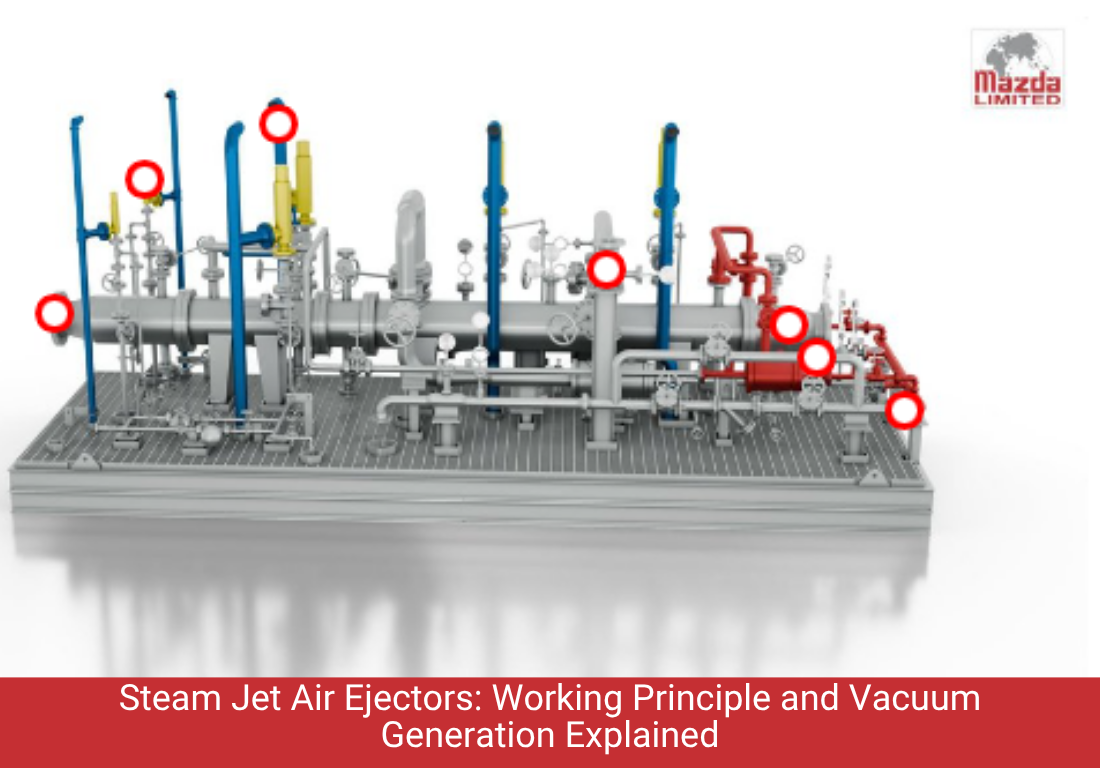
A Steam Jet Air Ejector, commonly abbreviated as SJAE, is one of the most widely used technologies for generating vacuum in industrial process equipment. It’s a common feature in distillation columns, evaporators, dryers, and turbine condensers, but the way it actually creates vacuum — using nothing but steam and a specially shaped nozzle — is less widely understood outside process engineering circles.
Mazda Limited, a steam jet air ejector manufacturer based in Ahmedabad, India, since 1977, has supplied SJAE systems across power, chemical, and process industries. This article explains what an SJAE is, how it works, and where it’s typically applied.
What Is a Steam Jet Air Ejector?
A Steam Jet Air Ejector is a vacuum-generation device that uses high-pressure steam, rather than a rotating mechanical pump, to remove air and non-condensable gases from a piece of process equipment. It’s sometimes referred to as a steam jet vacuum pump, though it has no conventional rotating components.
SJAE systems are used wherever a process needs to operate below atmospheric pressure — commonly to lower the boiling point of a liquid, which supports processes such as distillation, evaporation, and drying at reduced temperatures.
Speak with an Expert
How Does a Steam Jet Air Ejector Work?
An SJAE works on a straightforward thermodynamic principle. High-pressure motive steam is passed through a converging-diverging nozzle, which accelerates the steam to a very high velocity. As the high-velocity steam exits the nozzle, it creates a localized low-pressure zone.
This low-pressure zone draws in (“entrains”) air and non-condensable gases from the connected process equipment. The entrained gas mixes with the motive steam and passes through a diffuser section, where the mixture’s velocity is reduced and its pressure is recovered to a level suitable for discharge — either to atmosphere or to a subsequent ejector stage or condenser.
Because there are no moving parts involved in this process, an SJAE can offer simple, low-maintenance operation, provided the plant has a reliable and sufficient supply of motive steam.
Single-Stage vs. Multi-Stage SJAE Systems
SJAE systems can be configured with a single ejector stage or multiple stages arranged in series, often with inter-stage condensers between them. A single-stage ejector is generally used where a moderate vacuum level is sufficient. Multi-stage configurations, where the discharge of one ejector feeds the suction of the next, are used to achieve deeper vacuum levels than a single stage could reach economically on its own.
Inter-stage condensers, where used, condense the bulk of the steam between stages, which reduces the steam load on the following stage and improves the overall efficiency of a multi-stage system.
Common Applications of SJAE Systems
- Vacuum distillation — lowering the boiling point of process liquids to support separation of temperature-sensitive materials
- Evaporation and drying — supporting concentration or moisture removal at reduced temperatures
- Turbine condenser air removal — removing air and non-condensable gases from a power plant’s steam condenser to help maintain condenser vacuum
- Solvent recovery — supporting controlled evaporation of solvents from process streams
- Degassing — removing dissolved or entrained gases from process liquids
Advantages and Considerations of SJAE Technology
SJAE systems can offer several practical advantages, though — as with any vacuum technology — they come with trade-offs worth considering against the alternatives, such as liquid ring vacuum pumps or hybrid combination systems.
| Advantages | Considerations |
|---|---|
| No conventional moving parts in the ejector section | Requires a continuous, adequately sized steam supply |
| Generally low mechanical maintenance | Steam consumption is an ongoing operating cost |
| Can be configured for a wide range of vacuum levels via multi-staging | Efficiency can be affected by fluctuating process loads without proper design |
| Simple, well-proven design with a long service history | May be less suited to sites where steam is limited or costly |
Our Other Product
Materials of Construction for SJAE Systems
The materials used in an SJAE’s nozzle, diffuser, and body can significantly affect its service life, particularly where the motive steam or entrained gas stream is corrosive. Common construction materials include carbon steel, stainless steel, and various corrosion-resistant alloys, with the appropriate choice depending on the specific process gas composition, temperature, and any condensate chemistry involved.
Because material selection has a direct bearing on maintenance intervals and long-term reliability, it’s generally treated as part of the engineering design for each installation rather than a fixed specification applied across every application.
SJAE vs. Mechanical Vacuum Pumps — A Quick Comparison
An SJAE is often compared with mechanical vacuum pumps, such as liquid ring vacuum pumps, when a plant is deciding how to generate vacuum for a new or existing process. The core trade-off is straightforward: an SJAE avoids rotating equipment and its associated maintenance but depends on a continuous steam supply, while a mechanical pump doesn’t need steam but does require routine maintenance of moving parts and seals.
Where a plant already generates process steam and wants to avoid the maintenance associated with rotating equipment, an SJAE is often the first technology considered. Where steam is limited, costly, or unavailable, a mechanical vacuum pump — or a hybrid system combining both — tends to be evaluated instead.
How to Determine If an SJAE Is Right for Your Process
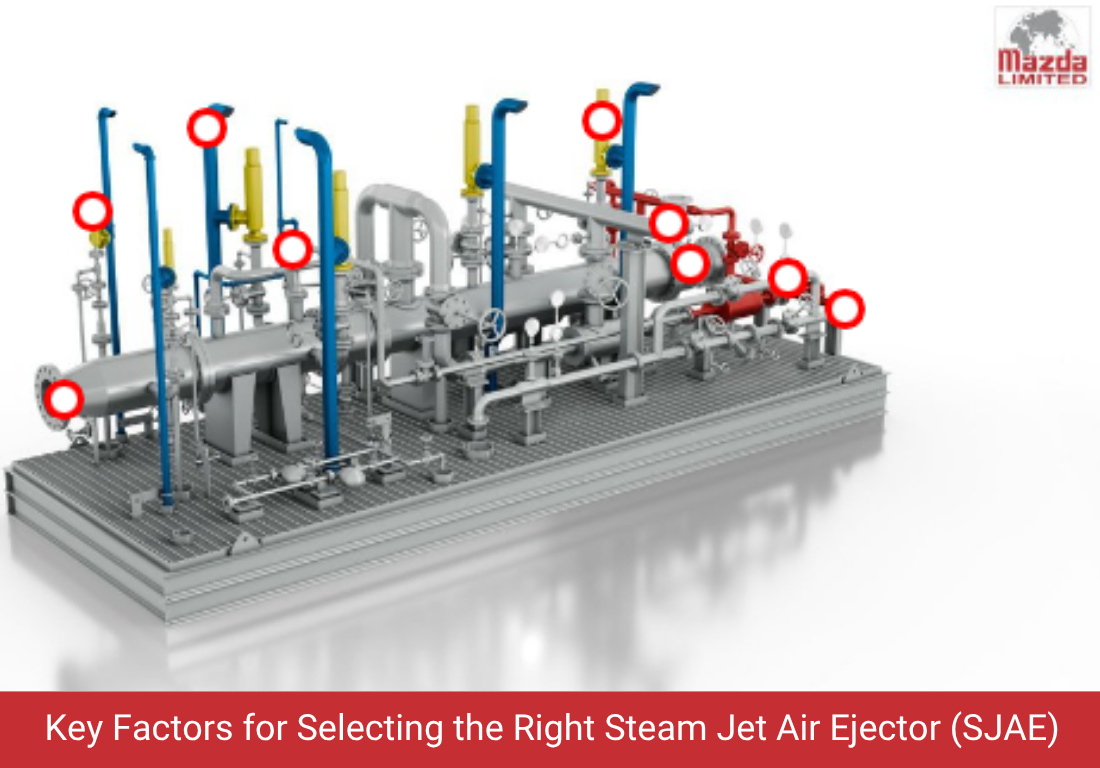
Whether an SJAE is the appropriate vacuum technology for a given application depends on several factors:
- Whether steam is already generated on-site and available at a suitable pressure
- The required vacuum level and whether single- or multi-stage configuration is needed
- The gas and vapor load the ejector needs to handle
- Whether the process load is steady or subject to significant variation
- Corrosive or fouling characteristics of the process gas, which influence material selection
Where steam availability is limited, or where a process experiences highly variable vacuum demand, a liquid ring vacuum pump or a combination system pairing an ejector with a mechanical pump may be worth evaluating alongside a standalone SJAE.
Read Our Article
Why Choose Mazda for SJAE Systems
- Application-specific SJAE design based on actual process and steam conditions
- Single-stage and multi-stage configurations, with or without inter-stage condensers
- Material selection suited to corrosive or high-temperature process gases
- Integration with condensers and other vacuum or heat transfer equipment
- In-house engineering and manufacturing, with technical and after-sales support
Quick Response Guaranteed
About Mazda Limited
Mazda Limited, established in 1977 and headquartered in Ahmedabad, India, is an engineering and manufacturing company specializing in industrial process equipment. Its capabilities extend across vacuum systems, heat transfer equipment, evaporation and crystallization, air pollution control, and non-chemical water treatment.
Mazda operates with certifications including ISO 9001, ISO 14001, and ISO 45001, along with relevant PED, IBR, ASME, and U-Stamp credentials across its engineering and manufacturing operations. The company develops equipment for domestic and international customers and focuses on application-specific engineering, manufacturing quality, and long-term technical support.
Conclusion
A Steam Jet Air Ejector remains one of the most widely used vacuum technologies in industrial process equipment because of its simple, low-maintenance design and its ability to be configured for a wide range of vacuum levels through staging. Its suitability for a given application depends primarily on steam availability and the specific vacuum and process requirements involved.
Looking for guidance on whether an SJAE system suits your process? Contact Mazda Limited to discuss your vacuum requirements and steam availability, and identify the right configuration for your application.
Frequently Asked Questions
What is a steam jet air ejector used for?
A steam jet air ejector is used to remove air and non-condensable gases from process equipment, generating vacuum for applications such as distillation, evaporation, drying, and turbine condenser operation.
Does an SJAE have moving parts?
No. The ejector itself has no conventional rotating or moving parts, which generally results in lower mechanical maintenance compared with pump-based vacuum systems.
What is the difference between single-stage and multi-stage SJAE systems?
A single-stage SJAE is generally used for moderate vacuum requirements, while multi-stage systems — where multiple ejectors operate in series, often with inter-stage condensers — are used to achieve deeper vacuum levels.
Can an SJAE work without a steam supply?
No. An SJAE requires a continuous supply of motive steam to operate. Where steam is unavailable or limited, a mechanical vacuum pump or a hybrid system may be more suitable.
How deep a vacuum can an SJAE achieve?
The achievable vacuum depends on the number of stages and the overall system design. Multi-stage configurations can achieve deeper vacuum levels than a single-stage ejector, and the specific requirement should be evaluated with actual process data.
Is a steam jet air ejector the same as a steam jet vacuum pump?
Yes, the terms are generally used interchangeably to describe the same technology — a device that uses high-velocity steam to generate vacuum.
What industries commonly use SJAE systems?
SJAE systems are used across power generation, chemical processing, petroleum refining, pharmaceuticals, and other industries where vacuum distillation, evaporation, drying, or condenser air removal is required.
Can an SJAE be combined with a liquid ring vacuum pump?
Yes. Combination vacuum systems pairing a steam jet ejector with a liquid ring vacuum pump are used in applications with variable vacuum loads or where the strengths of both technologies are needed.
Does Mazda manufacture SJAE systems?
Yes. Mazda Limited manufactures Steam Jet Air Ejector systems in single-stage and multi-stage configurations, engineered according to the specific process and steam conditions of each application.
What materials are SJAE systems typically made from?
Common materials include carbon steel, stainless steel, and corrosion-resistant alloys, selected based on the process gas composition, temperature, and condensate chemistry involved in the specific application.
Is an SJAE better than a mechanical vacuum pump?
Neither is universally better — an SJAE avoids rotating equipment but depends on steam, while a mechanical pump avoids steam dependence but requires routine maintenance of moving parts. The right choice depends on steam availability and maintenance considerations at the specific site.