


Read Our Article
What Is a Steam Jet Air Ejector (SJAE) and How Does It Work?
Zero Liquid Discharge (ZLD) is a wastewater treatment approach designed so that no liquid effluent leaves a plant. It’s typically achieved through a three-stage process train: an evaporator (MEE or MVR) removes the bulk of the water; a crystallizer (such as an OSLO Crystallizer) recovers dissolved solids as controlled crystals; and a dryer (such as an Agitated Thin Film Dryer, or ATFD) removes remaining moisture from the concentrated residue to produce a dry solid. The specific configuration depends on the wastewater’s composition and the plant’s treatment objectives.
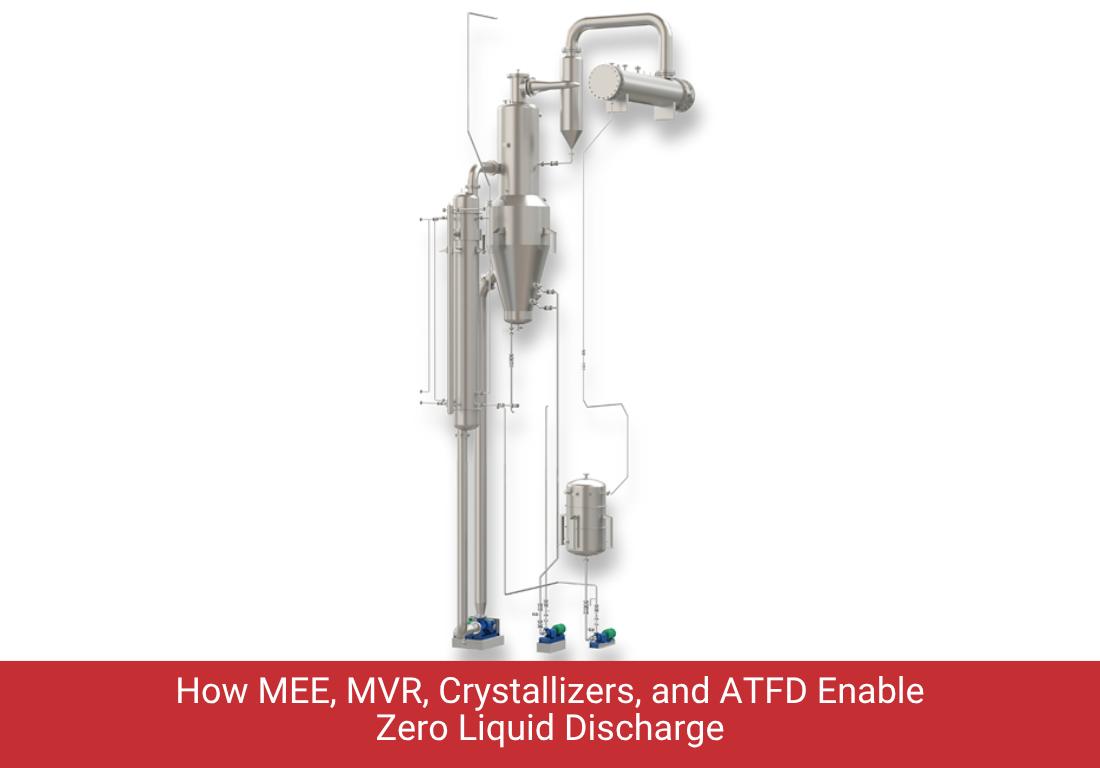
A Practical Look at How Evaporation, Crystallization, and Drying Combine to Eliminate Liquid Effluent
Zero Liquid Discharge, commonly abbreviated as ZLD, refers to a wastewater treatment approach designed so that no liquid effluent leaves a plant. Instead of discharging treated wastewater, a ZLD system recovers water for reuse and converts the remaining dissolved and suspended solids into a solid residue that can be disposed of or, in some cases, sold as a byproduct.
Mazda Limited, an evaporation and crystallization equipment manufacturer based in Ahmedabad, India, since 1977, supplies the core equipment used in ZLD process trains — evaporators, crystallizers, and dryers. This article explains how these technologies work together in a typical ZLD system.
Plants generally pursue ZLD for a combination of environmental and regulatory reasons, water-scarcity considerations, and — in some cases — the ability to recover valuable water or solid byproducts. Because a ZLD system eliminates liquid effluent entirely, it can be a preferred or required approach in industries and regions where wastewater discharge is tightly regulated or where fresh water availability is limited.
Achieving zero liquid discharge is rarely a single piece of equipment — it’s typically a multi-stage process train, with each stage responsible for progressively concentrating the wastewater until only a solid residue remains.
The first stage of a typical ZLD process train uses an evaporator — commonly a Multi Effect Evaporator (MEE) or a Mechanical Vapor Recompression (MVR) evaporator — to remove the bulk of the water from the incoming wastewater stream, concentrating the dissolved solids significantly.
MEE systems reuse vapor generated in one evaporation stage as the heating medium for the next, reducing steam consumption compared with single-effect evaporation. MVR systems instead use a mechanical compressor to recompress and reuse vapor, which can reduce dependence on continuous live steam — a consideration that’s often particularly relevant in ZLD applications, where overall utility and operating cost matters over the long run.
As the evaporator concentrates the wastewater further, dissolved solids can reach the point where they begin to crystallize out of solution. An OSLO Crystallizer, also known as a classified suspension crystallizer, is designed to promote controlled crystal growth under these conditions, producing a more uniform crystal size than uncontrolled precipitation would.
This stage recovers solids in a form that’s typically easier to separate, handle, and — depending on the application — potentially process further for reuse or sale.
What remains after evaporation and crystallization is a highly concentrated, often high-viscosity slurry that’s no longer practical to process through conventional evaporation. An Agitated Thin Film Dryer (ATFD) handles this final stage, spreading the concentrated feed into a thin film over a heated, mechanically agitated surface, allowing rapid final moisture removal.
The output from an ATFD is typically a dry solid, powder, or flake — a form that’s straightforward to handle, transport, and dispose of, completing the ZLD process with no liquid effluent remaining.
Read Our Article
What Is a Steam Jet Air Ejector (SJAE) and How Does It Work?
| Stage | Technology | What It Does |
|---|---|---|
| 1 — Bulk concentration | MEE or MVR Evaporator | Removes the majority of water from the incoming wastewater stream |
| 2 — Solids recovery | OSLO Crystallizer | Recovers dissolved solids as controlled, uniform crystals |
| 3 — Final drying | Agitated Thin Film Dryer (ATFD) | Removes remaining moisture from the concentrated residue, producing a dry solid |
Not every ZLD system uses all three stages in exactly this sequence — the specific process train depends on the wastewater’s composition, the solids’ crystallization behavior, and the plant’s specific treatment objectives. Some applications may also incorporate a solvent stripping unit where solvent recovery is part of the requirement.
ZLD systems can be technically demanding to design and operate, and a few challenges come up repeatedly. Scaling and fouling are common as the wastewater stream becomes more concentrated through each stage, which can affect heat transfer surfaces and requires appropriate material selection and cleaning provisions. Highly variable feed composition — common in industrial wastewater — can also make it harder to predict exactly where crystallization will occur, which is part of why crystallizer design is typically approached on a case-by-case basis.
Energy consumption is another recurring consideration, since evaporating large volumes of water is inherently energy-intensive. This is part of why the choice between MEE, TVR, and MVR evaporators at the first stage of a ZLD system matters — the energy efficiency of that stage has a significant effect on the overall system’s operating cost.
Our Other Product
Where the wastewater stream contains recoverable solvents in addition to dissolved solids, a solvent stripping unit may be incorporated into the process train, either ahead of the evaporation stage or as a parallel process. This can allow a plant to recover valuable solvent for reuse while still working toward the same zero liquid discharge objective for the remaining aqueous stream.
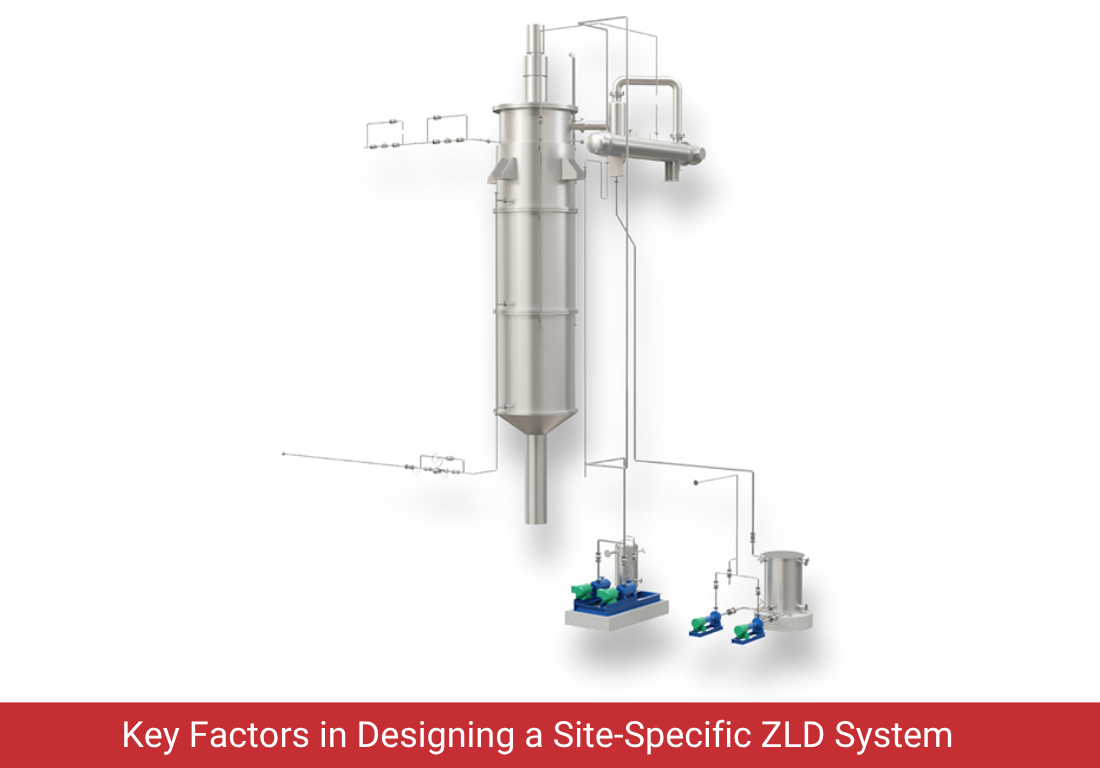
Because these factors vary significantly between plants and industries, a ZLD system is generally engineered around a specific site’s wastewater characteristics rather than supplied as a standard configuration.
Read Our Article
Mazda Limited, established in 1977 and headquartered in Ahmedabad, India, is an engineering and manufacturing company specializing in industrial process equipment. Its capabilities extend across vacuum systems, heat transfer equipment, evaporation and crystallization, air pollution control, and non-chemical water treatment.
Mazda operates with certifications including ISO 9001, ISO 14001, and ISO 45001, along with relevant PED, IBR, ASME, and U-Stamp credentials across its engineering and manufacturing operations. The company develops equipment for domestic and international customers and focuses on application-specific engineering, manufacturing quality, and long-term technical support.
Zero Liquid Discharge is generally achieved through a multi-stage process train rather than a single piece of equipment — typically an evaporator (MEE or MVR) to remove the bulk of the water, a crystallizer (such as an OSLO Crystallizer) to recover dissolved solids, and a dryer (such as an ATFD) to handle the final concentrated residue. Together, these stages allow a plant to eliminate liquid effluent while recovering water and solids for reuse or disposal.
Looking for guidance on designing a zero liquid discharge system for your plant? Contact Mazda Limited to discuss your wastewater characteristics and treatment objectives and identify the right combination of evaporation, crystallization, and drying equipment for your application.
Zero Liquid Discharge is a wastewater treatment approach designed so that no liquid effluent leaves a plant. Water is recovered for reuse and remaining dissolved and suspended solids are converted into a solid residue.
A typical ZLD process train uses an evaporator (MEE or MVR) for bulk concentration, a crystallizer (such as an OSLO Crystallizer) for solids recovery, and a dryer (such as an Agitated Thin Film Dryer) for final moisture removal.
MVR evaporators use mechanical vapor recompression rather than continuous live steam, which can reduce ongoing utility dependence — a consideration that's often significant in ZLD applications given their typically continuous, long-term operation.
An Agitated Thin Film Dryer handles the final drying stage, processing the highly concentrated, high-viscosity residue remaining after evaporation and crystallization into a dry solid, powder, or flake.
No. ZLD systems are generally engineered around a specific site's wastewater composition, crystallization behavior, and treatment objectives rather than supplied as a standard configuration.
Yes. Recovering water for reuse is typically one of the primary objectives of a ZLD system, alongside eliminating liquid effluent discharge.
Not necessarily. Whether a crystallization stage is included depends on the crystallization behavior of the dissolved solids in the specific wastewater stream and the plant's treatment objectives.
Mazda Limited manufactures the evaporation, crystallization, and drying equipment used in ZLD process trains, and can engineer these technologies together based on a plant's specific wastewater characteristics.
Common challenges include scaling and fouling as the wastewater becomes more concentrated, variable feed composition affecting crystallization behavior, and the energy intensity of evaporating large water volumes, which makes evaporator technology choice particularly important.
Yes. Where the wastewater contains recoverable solvents, a solvent stripping unit can be incorporated into the process train alongside the evaporation, crystallization, and drying stages.



Our team is available to provide professional support and will respond promptly to any inquiries or assistance you need.