


Read Our Article
Steam Jet Ejector vs. Liquid Ring Vacuum Pump: Which One Do You Need?
MEE (Multi Effect Evaporator) reuses vapor across successive evaporation stages to reduce steam use, and is a proven starting point where live steam is available. TVR (Thermal Vapor Recompression) adds a steam-jet thermo compressor to recompress vapor for further steam savings without added rotating equipment. MVR (Mechanical Vapor Recompression) uses a mechanical compressor instead of steam, minimizing live steam demand and often favored where electricity is cost-effective or the application is part of a zero liquid discharge (ZLD) system. Selection depends on feed characteristics, utility costs, and process requirements.
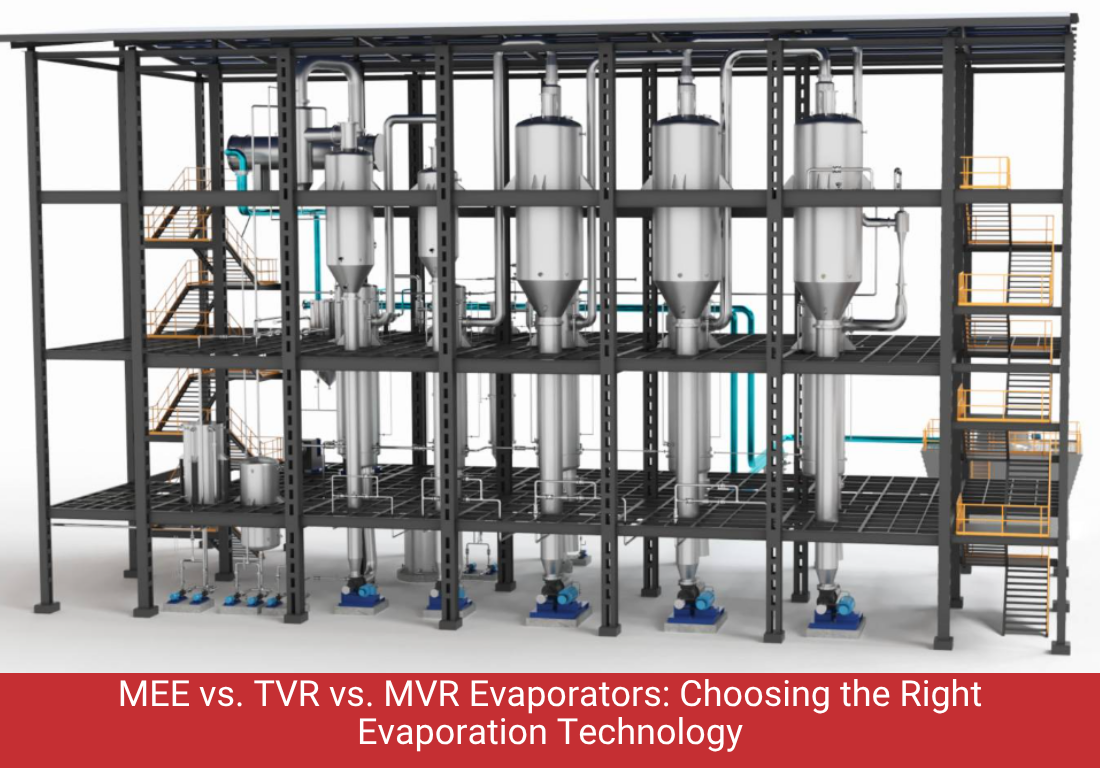
Understanding Three Approaches to Industrial Evaporation and How They Differ in Steam and Energy Use
Industrial evaporation is used across chemical, pharmaceutical, food, and effluent-treatment processes to concentrate liquids, recover valuable solids, and reduce wastewater volume. Three evaporator configurations are commonly used to do this — Multi Effect Evaporators (MEE), Thermal Vapor Recompression (TVR) evaporators, and Mechanical Vapor Recompression (MVR) evaporators. Each reuses the energy in evaporated vapor differently, and this difference has a direct effect on steam consumption, electricity use, and overall running cost.
Mazda Limited, an industrial evaporation equipment manufacturer based in Ahmedabad, India, since 1977, supplies all three configurations. This article looks at how each works, where each tends to be favored, and what to evaluate before choosing between them.
A Multi Effect Evaporator uses multiple evaporation stages, or “effects,” arranged so that the vapor generated in one effect is reused as the heating medium for the next. Because each effect operates at a progressively lower pressure and temperature, the vapor from one stage is hot enough to drive evaporation in the following stage.
This staged reuse of vapor energy reduces the fresh steam required compared with a single-effect evaporator. MEE systems are a well-established, relatively straightforward configuration and are often the starting point for evaporation applications where live steam is readily available.
A TVR evaporator adds a thermo compressor (a steam-jet device) to an evaporator system. The thermo compressor uses motive steam to recompress a portion of the vapor generated by the evaporator, raising its pressure and temperature so it can be reused as heating steam within the same or an earlier effect.
This recompression step can meaningfully improve steam economy compared with a plain MEE system, without introducing rotating mechanical equipment. TVR systems are often considered where a plant wants better steam utilization than a basic multi-effect arrangement but doesn’t have a strong reason to move to mechanical vapor recompression.
An MVR evaporator uses a mechanical compressor or blower, rather than motive steam, to recompress the vapor generated during evaporation and reuse it as the heating medium. Because the compression is done mechanically, an MVR system can operate with very little continuous live steam demand.
This can make MVR systems particularly relevant where electricity is more cost-effective than steam at a given site, or where a plant wants to minimize its dependence on a boiler for this part of the process. MVR is also frequently used in zero liquid discharge (ZLD) applications, where minimizing overall utility consumption is often a priority.
| Factor | MEE | TVR | MVR |
|---|---|---|---|
| How vapor is reused | Across successive effects | Recompressed via steam-jet thermo compressor | Recompressed via mechanical compressor |
| Steam requirement | Continuous live steam | Continuous motive steam, improved economy | Minimal live steam |
| Electricity requirement | Low | Low to moderate | Higher — compressor is electrically driven |
| Moving parts | Minimal | None in the thermo compressor itself | Yes — mechanical compressor |
| Typical starting point | Where steam is readily available | Where improved steam economy is wanted without added rotating equipment | Where electricity is favorable or live steam should be minimized |
Selection depends on the specific process and utility situation at a given site rather than a general preference for one configuration. Factors worth evaluating include:
| If your situation is… | The better starting point may be… |
|---|---|
| Steam is readily available and a straightforward, proven configuration is preferred | Multi Effect Evaporator (MEE) |
| Improving steam economy is a priority, without adding mechanical compression equipment | TVR Evaporator |
| Electricity is cost-effective relative to steam, or live steam should be minimized | MVR Evaporator |
This table is a general starting point rather than a substitute for engineering evaluation. Final selection should be based on detailed process data, utility costs, and site-specific conditions.
Our Other Product
Beyond steam and electricity requirements, MEE, TVR, and MVR systems also differ in typical capital cost and mechanical complexity. MEE and TVR systems generally involve less rotating equipment, which can mean lower capital cost and simpler maintenance in some cases. MVR systems include a mechanical compressor, which adds equipment cost and maintenance requirements, but this is often offset over time by reduced steam consumption, depending on the site’s utility pricing.
Because the balance between capital cost and long-term operating cost varies by site, a like-for-like cost comparison should be based on the specific plant’s utility rates, expected operating hours, and maintenance budget rather than a general assumption about which technology is “cheaper” overall.
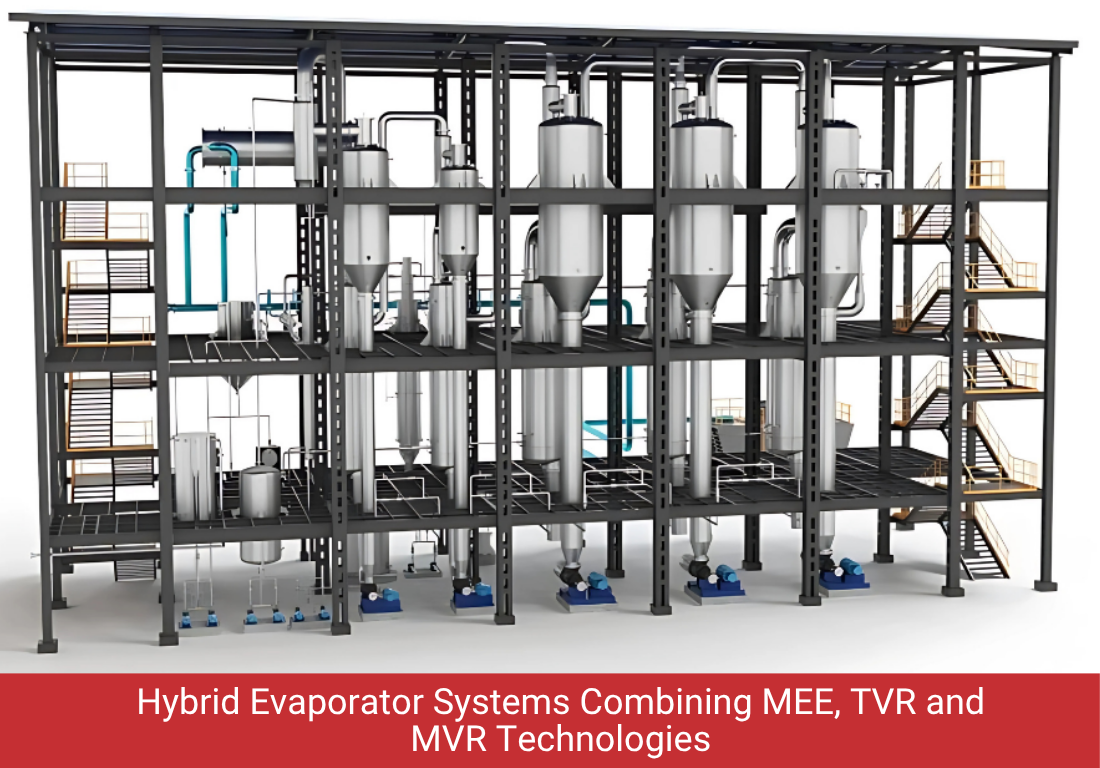
Some evaporation systems don’t rely on a single technology throughout. It’s not unusual for a multi-effect system to use TVR on its earlier effects, where motive steam is most efficiently applied, while a later stage uses MVR to handle a smaller residual vapor stream. This kind of hybrid arrangement can be considered where a plant wants to balance steam and electricity use across the full evaporation duty rather than relying on one mechanism throughout.
Mazda Limited manufactures MEE, TVR, and MVR evaporator systems, along with related crystallization and drying equipment. Because the company works across all three configurations, its engineering team can evaluate a plant’s feed characteristics and utility economics before recommending a system, rather than defaulting to one technology regardless of fit.
Mazda Limited, established in 1977 and headquartered in Ahmedabad, India, is an engineering and manufacturing company specializing in industrial process equipment. Its capabilities extend across vacuum systems, heat transfer equipment, evaporation and crystallization, air pollution control, and non-chemical water treatment.
Mazda operates with certifications including ISO 9001, ISO 14001, and ISO 45001, along with relevant PED, IBR, ASME, and U-Stamp credentials across its engineering and manufacturing operations. The company develops equipment for domestic and international customers and focuses on application-specific engineering, manufacturing quality, and long-term technical support.
MEE, TVR, and MVR evaporators each reuse the energy in evaporated vapor differently, and each can be the right choice depending on a plant’s steam availability, electricity cost, and process requirements. An MEE system offers a proven, relatively simple starting point; a TVR system can improve steam economy without added rotating equipment; an MVR system can minimize live steam demand where electricity is favorable.
Looking for guidance on which evaporator configuration suits your process? Contact Mazda Limited to discuss your feed characteristics and utility situation and identify the right evaporation technology for your application.
MEE evaporators reuse vapor across multiple effects. TVR evaporators use a steam-jet thermo compressor to recompress vapor for reuse. MVR evaporators use a mechanical compressor instead of steam to recompress vapor. Each has a different steam and electricity requirement.
MVR evaporators are generally designed to minimize live steam demand by using mechanical rather than steam-driven vapor recompression. The actual steam and electricity balance depends on the specific application and site conditions.
Not necessarily. MVR can be advantageous where electricity is cost-effective relative to steam, but TVR or MEE may be more appropriate where steam is readily available or where minimizing mechanical equipment is preferred. Selection should be based on the specific site's utility economics.
A thermo compressor is a steam-jet device that uses motive steam to recompress part of the vapor generated during evaporation, allowing it to be reused as heating steam and improving overall steam economy.
Yes. All three can be used in ZLD process trains, often combined with crystallizers and drying equipment such as an Agitated Thin Film Dryer (ATFD) to achieve the required level of liquid discharge reduction.
Depending on the existing configuration and site conditions, upgrades or retrofits may be possible. This requires an engineering evaluation of the existing system and the intended improvement in steam or energy performance.
Selection should be based on feed characteristics, required concentration, steam and electricity availability and cost, capital budget, and whether the application is part of a ZLD process. A detailed process evaluation is recommended before finalizing the configuration.
Yes. Mazda Limited manufactures MEE, TVR, and MVR evaporator systems, along with associated crystallization and drying equipment for complete process trains.
Yes. Some multi-effect systems use TVR on earlier effects and MVR on later stages to balance steam and electricity use across the process. The suitability of this approach depends on the specific plant's evaporation duty and utility situation.
MEE and TVR systems generally involve less rotating equipment than MVR systems, which can mean lower capital cost in some cases. However, the full cost comparison should also account for long-term operating costs, which depend on site-specific utility pricing.



Our team is available to provide professional support and will respond promptly to any inquiries or assistance you need.