


Read Our Article
What Is a Steam Jet Air Ejector (SJAE) and How Does It Work?

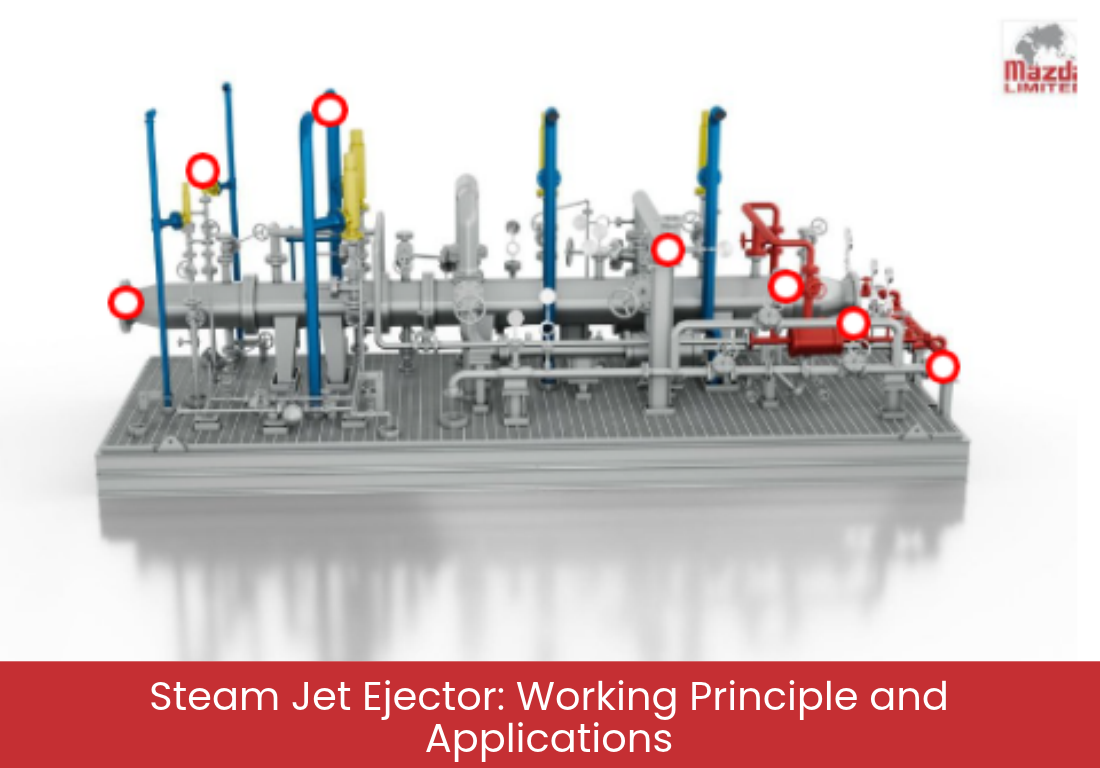
Vacuum generation is essential in many industrial processes, including chemical manufacturing, distillation, evaporation and drying. These operations need air, non-condensable gases or process vapours removed so the equipment can run at the required pressure.
A steam jet ejector uses the energy of high-pressure steam to draw out and transport these gases. Unlike mechanical vacuum equipment, it has no impeller, piston or other moving parts in the ejector body.
Understanding the steam jet ejector working principle helps engineers and plant operators see how ejector systems create vacuum, what drives their performance, and when a single-stage or multi-stage arrangement is the right fit.
A steam jet ejector is a fluid-driven device that uses a high-velocity steam jet to draw in and transport another gas or vapour stream. The high-pressure steam is called the motive fluid. The gas or vapour drawn in through the suction connection is called the suction stream.
A steam jet ejector can work as a standalone single-stage unit, in multiple stages, or as part of a larger vacuum system with condensers and other equipment. The final configuration depends on the process load, required suction pressure, steam conditions and operating requirements.
The working principle of a steam jet ejector rests on two ideas. Pressure energy is converted into velocity energy, and momentum is transferred from a high-velocity steam jet to the gases being removed. Here is how it happens, step by step.
Motive steam enters the ejector nozzle at the specified pressure. The nozzle accelerates the steam, converting its pressure energy into kinetic energy. The nozzle geometry and steam conditions determine the jet velocity and the ejector’s operating characteristics.
As the steam accelerates, it creates a low-pressure region at the nozzle outlet. This pressure difference draws air, non-condensable gases or process vapours into the ejector through the suction connection.
The high-velocity steam jet entrains the incoming gases or vapours. Momentum transfers from the motive steam to the suction stream as the two mix, and the combined stream moves towards the diffuser.
Inside the diffuser, the flow slows down and its velocity energy is converted back into pressure energy. Diffuser design is critical because it governs pressure recovery and overall ejector performance.
The combined stream leaves the ejector at the discharge pressure the system requires. Depending on the application, it may flow to a condenser, another ejector stage or other downstream equipment.
These steps happen continuously, so the ejector keeps removing gases from the connected equipment and maintains a stable vacuum.
Read Our Article
What Is a Steam Jet Air Ejector (SJAE) and How Does It Work?
This supplies high-pressure steam to the ejector. Steam pressure, temperature and quality must match the ejector design to deliver the intended performance.
The nozzle converts pressure energy into velocity energy. Its geometry shapes the high-velocity jet and directly affects how well the ejector entrains the suction stream.
The suction inlet connects the ejector to the equipment from which gases or vapours must be removed. The pressure difference created by the steam jet draws the suction stream in.
Here the motive steam and suction stream mix. Momentum transfer accelerates the entrained gases and forms a single combined flow.
The diffuser slows the combined stream and converts its kinetic energy back into pressure, so the mixture reaches the required discharge pressure.
In multi-stage systems, condensers are installed between ejector stages. They condense a large share of the steam, which reduces the vapour load on the next stage.
The choice between one stage and several depends mainly on the required vacuum level, gas load, motive steam conditions and process requirements.
| Feature | Single-Stage Ejector | Multi-Stage Ejector |
|---|---|---|
| Configuration | One ejector stage | Two or more ejector stages |
| Vacuum Requirements | Suited to applications within one stage’s operating range | Used when a deeper vacuum is required |
| System Arrangement | Simple | Additional stages, often with interstage condensers |
| Interstage Condensers | Not required | Commonly used to reduce steam load on later stages |
| Selection Factors | Suction pressure, gas load and discharge pressure | Required vacuum, stage pressure ratios, gas load and condensation needs |
A multi-stage arrangement is not needed for every application. A single-stage ejector is the right choice when the required vacuum and discharge pressure fall within its design limits.
When motive steam mixes with suction gases, the resulting stream contains a large amount of water vapour. A condenser cools this mixture so most of the steam condenses before the remaining gases move to the next ejector stage.
This reduces the vapour load on subsequent stages and improves the system’s overall steam utilization.
Two main condenser types are used:
The right choice depends on process requirements, condensate handling, cooling-water conditions and whether the process stream must stay separate from the cooling medium. Steam jet air ejector systems are often paired with surface condensers for optimal performance.
Our Other Product
The ejector works through fluid flow, momentum transfer and pressure recovery rather than rotating or reciprocating mechanisms. The result is a simple, compact ejector body.
With no moving parts in the ejector body, there is no routine mechanical servicing of the kind rotating vacuum machinery needs. This supports a long operational life. Maintenance of the complete system still depends on steam quality, condensers, valves and auxiliary equipment.
Arranged in multiple stages, steam jet ejectors operate efficiently at the high vacuum levels that demanding industrial processes require.
Ejectors can be built from corrosion-resistant materials matched to the gases, vapours and condensate in the process.
Ejectors integrate with surface condensers, direct-contact condensers and hybrid vacuum systems to form a complete solution tailored to the process.
Ejector systems are designed around the required suction pressure, gas composition, motive steam conditions and discharge pressure, in single-stage or multi-stage configurations.
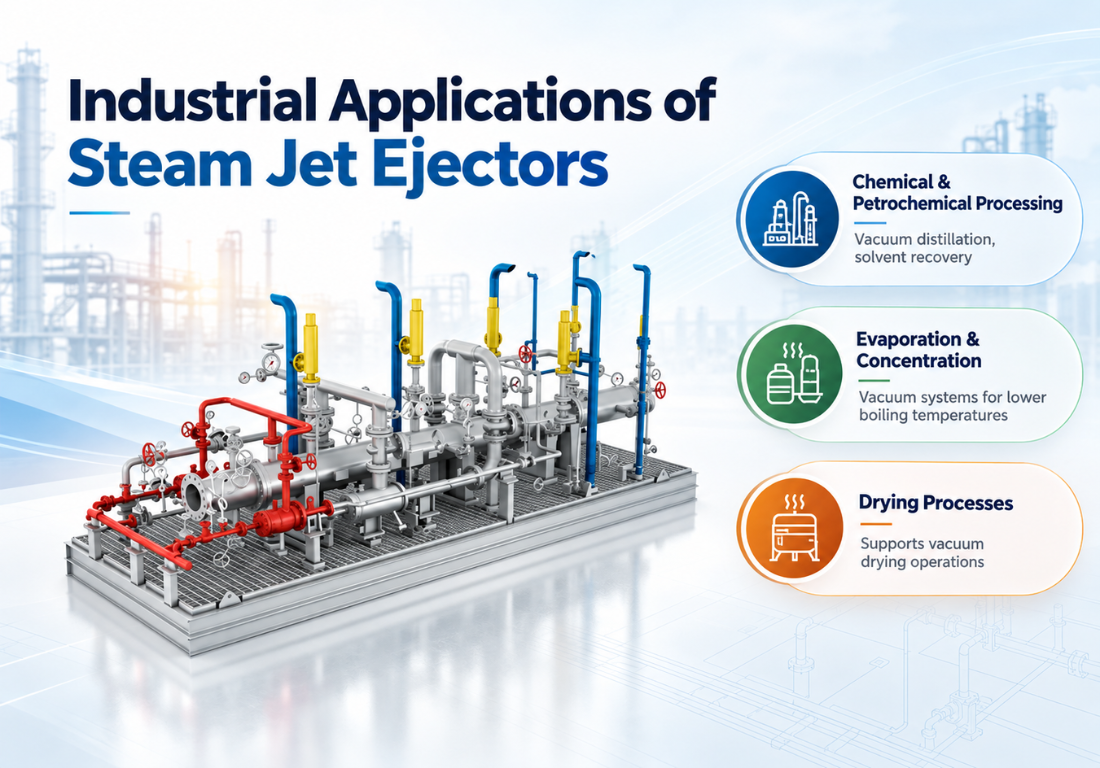
Steam jet ejectors support vacuum distillation, solvent recovery and other operations where gases or vapours must be removed. Configuration depends on the process composition, pressure requirements and available motive steam.
Vacuum lowers the boiling temperature of liquids, which makes it valuable in evaporation and concentration. Ejectors are commonly part of the vacuum systems serving these processes.
Vacuum drying uses reduced pressure to remove moisture or solvents under controlled conditions. Ejector design depends on the vapour load, required vacuum and downstream condensation arrangement.
Steam jet air ejectors remove air and non-condensable gases from condenser systems in steam-cycle applications, helping maintain the vacuum the equipment needs to operate as intended.
Vacuum is required for drying, evaporation and solvent handling. System design must account for the process stream, operating pressure and chemical compatibility.
Ejector-based vacuum systems are used where air or vapour removal is required. The specific application and required capacity determine the arrangement.
Reliable selection depends on verified process data and ejector performance calculations, not stage count alone.
A thermo compressor works on the same nozzle-and-diffuser principle as a steam jet ejector. The difference is the job it does. Instead of creating vacuum, it uses high-pressure motive steam to entrain low-pressure steam and raise it to a usable discharge pressure, so that steam can be reused in the process.
Our Steam Jet Air Ejector (SJAE) System is a robust, energy-efficient solution for removing air and non-condensable gases from process equipment. It maintains stable vacuum conditions in applications such as distillation, evaporation and drying across diverse industries.
Each system is custom-designed in-house around the operating parameters of the process. Single-stage and multi-stage configurations are available depending on the vacuum level required, and our systems are often paired with surface condensers for optimal performance. Backed by decades of experience, our ejector systems are built for long-term reliability.
Our Other Product
To help us design the right system, share your required suction pressure, gas load, motive steam conditions, discharge pressure and process composition.
A steam jet ejector is a device that uses high-pressure steam to entrain and transport air, gases or vapours. It converts steam pressure energy into velocity through a nozzle and recovers that energy as pressure in a diffuser.
High-pressure steam accelerates through a nozzle and creates a low-pressure region that draws gases or vapours from the connected equipment. The steam entrains this suction stream, and the combined flow passes through a diffuser for pressure recovery and discharge.
The nozzle accelerates the motive steam by converting pressure energy into velocity energy. Its design shapes the steam jet and determines how well the ejector entrains the suction stream.
The diffuser slows the combined stream of steam and entrained gases and converts its kinetic energy back into pressure, so the mixture can discharge at the required pressure.
A single-stage ejector uses one stage, while a multi-stage system uses two or more. Multi-stage systems are designed for deeper vacuum and often include condensers between stages to reduce steam load.
Condensers remove much of the condensable steam from the gas mixture between stages. This reduces the vapour load on later stages and improves steam utilization across the system.
A steam jet air ejector is designed to remove air and non-condensable gases from process equipment. Suitability for other gases or vapours depends on their composition, temperature, flow rate and the system’s construction materials.
Steam jet ejectors have a simple, compact design with no moving parts. They need little maintenance, operate efficiently at high vacuum, can be built from corrosion-resistant materials, and integrate with condensers or hybrid vacuum systems.
They are used in chemical processing, distillation, evaporation, drying, power generation, pharmaceuticals, and pulp and paper manufacturing.
Both use the same nozzle-and-diffuser principle. A steam jet ejector creates vacuum by removing air and gases, while a thermo compressor raises low-pressure steam to a usable pressure so it can be reused in the process.
Selection depends on required suction pressure, gas load, motive steam pressure and quality, discharge pressure, vapour composition, condenser requirements and expected operating variations. Performance calculations based on verified process data should confirm the right configuration.
A steam jet ejector creates vacuum by turning high-pressure steam into a high-velocity jet that entrains gases or vapours, then recovering pressure in a diffuser. Single-stage units suit moderate duties, while multi-stage systems with interstage condensers handle deeper vacuum requirements.
We design Steam Jet Air Ejector systems in-house alongside combination vacuum systems, thermo compressors, condensers and evaporators. This lets us recommend a standalone ejector or a complete vacuum solution based on your process requirements.





Our team is available to provide professional support and will respond promptly to any inquiries or assistance you need.